


Blog
The Story of the Shenzhen Pop Culture Exhibition: When “The Right Thing for Geeks” Loses to “What the Masses Like”

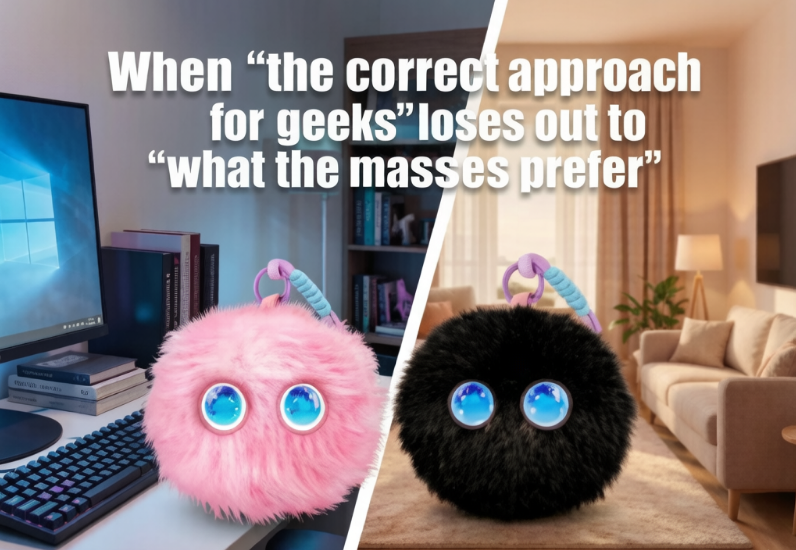
At the bustling pop culture toy exhibition in Shenzhen, I was struck by a strong sense of disconnection. On one side of the exhibition hall, there was a section dedicated to “AI intelligent toys” with their shiny, technological cold light. The exhibitors there proudly demonstrated their products: the real-time integration of large models enabled the toys to respond fluently, the complex memory system could repeat conversations from three months ago, and there were also cool emotion recognition and Agent autonomous planning capabilities. The air was filled with an overwhelming sense of superiority, believing that technology would always prevail.
On the other side of the exhibition hall, there were toy manufacturers from Chaoan, Chaoan. Their booths were relatively plain, and their products were far less “intelligent”. The so-called “AI” was merely a few simple audio recordings or a few preset touch responses. Strictly speaking, they even couldn’t be considered true AI.
However, a dramatic scene unfolded. At the booths with a strong technological feel, visitors often marveled at the magic of technology and then turned away; but in front of the “less intelligent” Chaoan toys, there were always crowds. Children loved to play with them, adults were interested in asking prices, and even made purchases on the spot. At that moment, a cold and real realization pierced through me: The biggest problem with AI toys at present is not that their capabilities are insufficient, but that we mistakenly equate the “value of technological capabilities” with “the value of the product itself”.
I. The arrogance of technology: Falling into the “correctness” trap
In the current AI toy industry, there is a collective “technological correctness” myth. Almost all teams are doing the same thing: spending unlimited resources to integrate the most advanced large models, refining voice interaction with millisecond response times, designing complex long-term memory networks, and even attempting to endow toys with an autonomous Agent system.
From a purely technological product perspective, these efforts are understandable and even the cornerstone of industry progress. However, the fatal mistake lies in forgetting the definition of the category – what users buy is not an “AI product”, but a “toy”.
The ancient “toy” industry, from its very first day of existence, has never been a “capability-driven” field. Looking back at those classic toys that have survived through cycles, their success has nothing to do with computing power, and even less with the strength of functions.
II. The essence of toys: Low functionality and high emotional density
If we look back at the development history of the toy industry, we will discover an extremely counter-intuitive fact:
Cotton toys: With almost no electronic functions, just a ball of cotton and fabric.
Cultural collectible figurines: Completely non-interactable, just static resin models.
Blind boxes: Essentially a probability game, with functions so limited that they are almost non-existent.
But they can still sell extremely well, even triggering buying sprees. Why? Because what toys truly sell are not the problem-solving capabilities, but three deep psychological needs: emotional projection (I love it because it’s cute); identity _expression (owning it represents being a member of a certain circle); and psychological satisfaction (the joy brought by possessing it itself).
The essence of toys is low functionality + high emotional density. When we try to “arm” toys with complex technology, we often break this delicate balance, making simple pleasures heavy and complex.
III. The misplacement of AI: Not making toys stronger, but making emotions easier to obtain
The entry of AI technology into the toy industry should have been a wonderful thing. But its current application direction has deviated. We overly emphasize that AI makes toys “stronger” and “smarter”, while ignoring what it should do most, which is to make emotions easier to be created and perceived.
Think about it, do users really need a toy that can help them check the weather or solve math problems? No. What they need is the feeling of being “seen” and “responded to”.
For example, when the toy responds to your touch, it’s a feeling of being responded to; when it remembers the things you said last week, it’s a feeling of being cared about; when it acts like a child and teases or complains to you, it’s an excellent carrier of emotional projection. These experiences do not require a trillion-parameter large model or a complex operating system. They only need an “illusion of just being alive” effect. Excessive technological accumulation will break this illusion, causing users to withdraw from the emotional immersion and realizing that this is just an expensive electronic product.
IV. The Chonghai Revelation: The Victory of Light AI Toys
The Chonghai manufacturers at the exhibition accidentally hit the pulse of the times. Although their products are technologically simple, they possess three core advantages that enable the product to explode:
Firstly, an extremely low decision-making threshold. Users do not need to understand what a Transformer architecture is, nor do they need to know what NLP is. They just need to think “this thing is a bit fun”, and they can buy it without hesitation.
Secondly, an extremely low usage threshold. Open the package and play, touch and there is a response. There is no cumbersome networking process, no learning cost.
Finally, just the right emotional feedback. It is not complex, but “responsive”. This “just right” state is exactly what the current AI toy market is most lacking.
This points to a completely new product category: Light AI Toy. It does not aim to be as intelligent as a human, nor does it seek to be a household assistant. Its sole aim is to be an entity that can be liked. It is not an all-rounder assistant but a dedicated playmate.
V. The Division of the Industry: Two Completely Different Paths
If you continue to observe, you will find that this industry is irreversibly splitting into two completely different paths:
Path One: Capability-driven AI Toys.
This path pursues stronger models, more complex systems, and longer conversation histories. They increasingly resemble robots and computers, but increasingly less like toys. They attempt to conquer users with technology, but often exclude mass consumers due to their high prices and complex operations.
Path Two: Emotion-triggered AI Toys.
This path pursues light interaction, strong IP, and quick feedback. They are more like “toys with a bit of life”. They do not attempt to teach users anything, but rather try to please users.
In the short term, the former is more eye-catching and more in line with the aesthetics of geeks; but from the perspective of long-term commercial scale, the latter is more likely to become the mainstream. Even saying something counterintuitive: The AI toys that sell the most in the future might be the ones that are “the least like AI”.
VI. Conclusion: Redefining AI Toys
If we are to give a definition to the next generation of AI toys, I prefer to describe it like this: It should not be a “stronger AI”, but rather an entity that is easier to be liked, relied upon, and even have a deep emotional relationship with.
Technical capabilities are merely the means to achieve this goal; emotion is the essence of the product.
At that moment at the Shenzhen Pop Culture Expo, I suddenly realized that we have been striving to do “the right” things – pursuing the ultimate of technology. But the direction might have been off from the very beginning. We tried to solve emotional problems with rational computing power, but forgot the ultimate mission of toys, which is to bring the simplest and purest happiness to humans. Perhaps it’s time to let go of the obsession with “intelligence” and return to the insight into “the human heart”.