


Blog
The Controversy of Emotional Entry Points: When AI Toys No Longer Just Toys, But Become Your First Emotional Response

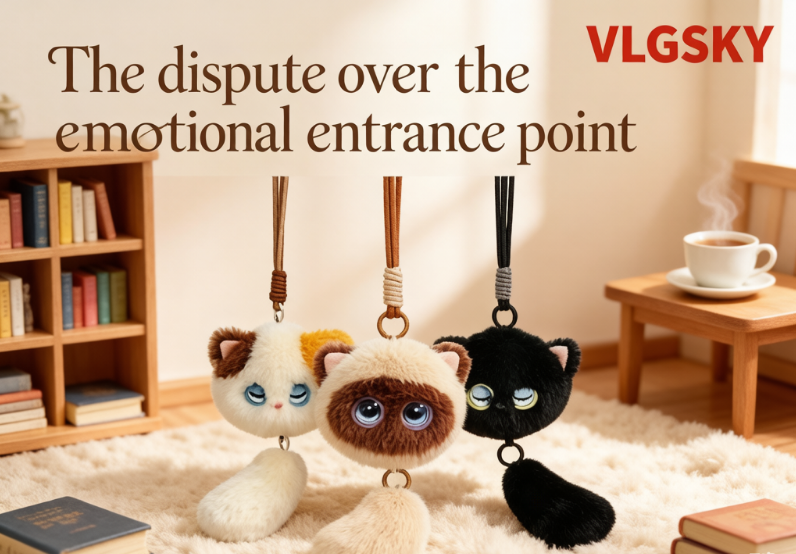
Recently, reports about several newly launched AI toys have caught my attention. MOMOTOY, Unee, Blinkko, and Ludens – these four products have distinct forms and very different business logic. On one side, MOMOTOY, which was established less than four months ago and has a valuation of 250 million, is a new AI toy sensation; on the other side, Unee, which is sold at over a thousand yuan on TikTok and is still in high demand despite its price, is an AI plush companion; there is Blinkko, which claims to “not provide companionship” but simply lies on your shoulder as a pet; and Ludens, a robot that refuses to speak human language but attempts to become a “family member”.
If we only look at the product definition, they seem to be running on four parallel tracks, not interfering with each other. But if you look beyond the surface and delve deeper, you will find a chilling consensus: They are not making the same type of product, but they are all competing for the same thing – to become the “first emotional carrier” of the user’s “first reaction”.
Unee is seizing the “emotional venting entrance”, trying to be the object that is instinctively held when the user is lonely or depressed; Blinkko is seizing the “social expression entrance”, trying to be the accessory that showcases personality and sparks conversation when the user goes out; Ludens is seizing the “long-term companionship entrance”, trying to be the silent but constant presence in the user’s home space; and MOMOTOY is seizing the “emotional consumption entrance”, trying to bind emotional value with collection attributes and become the user’s first choice to pay for “mood”.
This is not a simple product competition, but a war about “occupation”. Whoever can be subconsciously recalled, grabbed, and relied on at the moment when emotions occur will hold the key to the future.
I. Broken “Turing Test”: When “more like a human” is no longer the gold standard
For a long time, our judgment criteria for AI toys have been stuck in an intuitive misunderstanding: Who is better at chatting? Who has a higher emotional quotient? Who is more like a real person? But these four cases have ruthlessly shattered this logic.
Blinkko even deliberately weakens its language ability, and Ludens directly refuses to speak human language. They seem to be declaring: We don’t believe that AI can perfectly imitate humans, nor do we attempt to replace humans. If “more like a human” is not the only answer, then what is the core of the AI toy competition?
The answer is surprisingly simple: In the competition for “when you will remember it”.
By dissecting these four products, you will find that they are all trying to anchor a specific emotional trigger moment: Unee is the object you want to talk to when you are in a deep emo mood at night; Blinkko is the accessory you want to wear when you go out for social interaction; Ludens is the companion that your gaze will naturally fall on when you are at home on the weekend; MOMOTOY is the emotional consumer product you want to own when you pass by the trendy toy store out of a momentary impulse. Their common point is not the strength of AI capabilities, but they are all trying to occupy the moment when emotions occur. Will you want to open it when you are lonely? Will you want to touch it when you are bored? Will you talk to it when you long for understanding?
The essence of this competition has long transcended the technical level of “who is more intelligent” and evolved into who can become your “first emotional entrance”.
II. Dimensional Shift: From “Object” to “Entrance”
This shift in the logic of competition marks that the AI toy industry has completed a dimensional leap.
The logic of traditional toys is linear: buy → play → idle. It is an object that is consumed, and the transaction basically ends at the moment it is completed.
The first version of trend toys goes further: buy → collect → social display. It has a certain social attribute, but it is still static and has limited interactivity. And AI toys are pioneering a third mode: use → interaction → forming habits. They are no longer passive objects but rather an entrance that is repeatedly accessed.
This transformation is comparable to the “entrance” competition in the Internet era. WeChat is the social entrance, Douyin is the entertainment entrance, and Xiaohongshu is the recommendation entrance. These products are great not because of their complex functions, but because they occupy a core path of users’ daily behaviors. What AI toys are doing is becoming an “emotional entrance” – a traffic hub that receives human emotions of joy, sorrow, loneliness, and happiness.
Once a product is defined as an “entrance”, its attributes are completely transformed. It is no longer a commodity waiting to be selected on the shelf, but an indispensable part of users’ lives. This qualitative change from “object” to “entrance” is the key to the revaluation of the AI toy industry.
III. Emotion: The Underlying Driving Force of All Consumption
Why is the “emotional entrance” so important? Because emotion is the most fundamental and primitive driving force of all consumption behaviors.
You buy toys to gain happiness; you watch short videos to seek relaxation; you keep pets to get companionship. In the past, these needs were cut and satisfied by different products. But the emergence of AI technology has made it possible for one carrier to continuously and seamlessly receive the flow of human emotions.
That’s why some people are willing to pay thousands of yuan for a plush toy that can chat – they are not buying plastic and chips, but the feeling of being responded to; that’s why some people develop a dependence on a device that “remembers itself” – they are not seeking information storage, but the experience of being cared about. Behind these seemingly irrational consumption behaviors, there is a deep craving for emotional connection. AI toys are the ultimate carrier of this craving.
IV. Consensus in Division: Clarification of Industry Direction
Interestingly, although these four cases are drastically divided in form and positioning, this division precisely indicates the maturity of the industry – it no longer attempts to define AI with a single standard answer, but is exploring various possibilities of the relationship between AI and humans.
Some are trying to replace humans (such as Unee, providing emotional companionship);
Some are trying to connect humans (such as Blinkko, as a social medium);
Some are trying to become “like life” (such as Ludens, as a family member);
Some are trying to strengthen consumption (such as MOMOTOY, emotion + assets).
This seemingly chaotic situation actually points to a more fundamental issue: What should AI be? Not what AI can do. This is a philosophical reflection and also a sign that the industry is shifting from technology-driven to value-driven.
V. Conclusion: Technology will level, but “position” will not
Finally, we must face a harsh and real judgment: The technical barriers are fragile.
The exclusive model you have today may be open-sourced tomorrow; the smooth conversation you can achieve today may be replicated by all competitors tomorrow. AI capabilities will become as widespread as electricity, becoming cheap and homogeneous. But one thing will never be leveled: User habits.
Once users have formed the habit of opening you, relying on you, and carrying you in a certain specific emotion, you are no longer just a product, but an unshakable “position”. This “position” – in the emotional coordinates of users – is the true and impregnable barrier.
MOMOTOY, Unee, Blinkko, Ludens, they may have different forms and unknown success or failure, but they all point to the future of AI toys: The one who gets the emotional entrance, gets the world. In this battle over “the first reaction”, whoever manages to seize the dominant position in users’ minds will define the human-computer relationship of the next decade.