


Blog
Reverse Creation: Three Hours, From Chaos to Clarity – A “Subtraction Surgery” on AI Toys

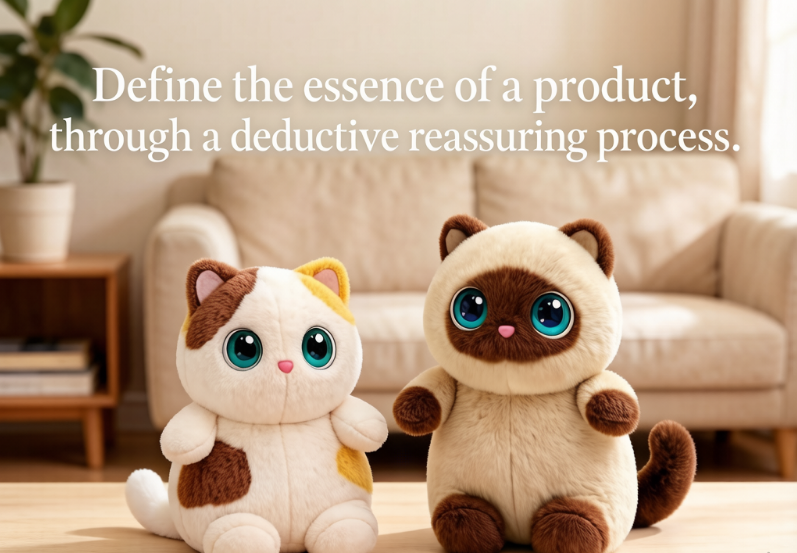
In the minds of most people, the birth of an AI toy follows a linear and “engineering-oriented” path: inspiration strikes, sketches are drawn, a large model is connected, prototyping is tested, and finally, mass production is carried out. This seems to be an unquestionable truth. However, a recent experiment conducted in a closed meeting room has completely overturned this traditional process. We did not write a single line of code, did not use complex development tools, and even did not produce a complete design rendering. In just three hours, we merely relied on logical reasoning and repeated questioning to forcefully “push” an originally vague and chaotic idea into a logically coherent and highly feasible AI plush toy solution.
When the meeting ended, the whiteboard was filled with notes and then wiped clean, leaving only a few scattered marks. But every person in the room was extremely confident: This thing can be done, and they know exactly how to do it step by step. This is not magic; it is a “subtraction surgery” about product definition.
I. The first hour: Harsh screening – Rejecting 80% of “false ideas”
At the beginning of the meeting, when someone proposed “We should create a plush toy that can chat” or “Develop an AI product that provides emotional companionship”, these seemingly correct visions often faced the harshest questioning within the first hour. Because these expressions were essentially just “descriptions” rather than “products”. They were like a fog, seemingly grand but unable to be implemented.
Our first hour’s core task was not “creation”, but “negation”. We would peel away these grand concepts layer by layer. One of the most typical traps was “providing emotional companionship for young people”. This sentence was perfect in a business plan, but it couldn’t withstand scrutiny: Which group of young people? Are they those office drones working 996 in big companies or the confused students on the university campus? What kind of emotions? Is it the anxiety of insomnia at night or the exhaustion after socializing during the day? In what scenario? Is it in a solitary apartment or a crowded subway?
Most ideas, when questioned by the three consecutive questions of “who”, “what emotion”, and “what scenario”, would instantly seem pale and powerless, and would be directly rejected. At the end of the first hour, the whiteboard usually only had one barely tenable direction. It may not be perfect, and even a bit rough, but it passed the “concretization” test – it at least pointed to a real person and a real, tangible pain point. This surviving direction is the cornerstone of all our subsequent work.
II. The second hour: Building relationships – From “function list” to “use moment”
When the direction is determined, the habitual thinking will immediately shift to function definition: Should there be voice recognition? What is the memory length? Should it be connected to weather queries? But in our process, the second hour strictly prohibits any discussion of technical parameters. We only focus on one thing: Designing relationships. More precisely, depicting that “moment when the user picks up the toy”.
We will ask team members to close their eyes and describe that specific scene over and over again: “A 22-year-old girl in Shanghai at 2 a.m., just finishing a mentally exhausting overtime. She returns to an empty apartment and doesn’t open her phone to watch short videos, but instinctively picks up the plush toy on the bedside. She buries her face in its fur and sighs softly. At this moment, what does she want this toy to do? Is it to tell a joke or just to quietly accompany her, emitting simulated heartbeat sounds?”
You will find that the product’s prototype is not drawn out, but naturally “grows” out of the repeated chewing of these details. That “lonely night seeking comfort” scene is more important than any function list. It defines the core value of the product – not “what can it do”, but “in what circumstances, providing an irreplaceable experience”. By the end of the second hour, we no longer have a concept, but an extremely specific “use moment”. This moment is the embryo of the product’s soul.
III. The third hour: Backward deduction for implementation – From “soul” to “body”
It was not until the third hour that we truly began to touch on the “product’s” physical form. Should we make it a long plush toy or a short one? Should it be a cat or a bear? Should an AI chip be added? Where is the cost limit? How should the first version of the minimum viable product (MVP) be defined?
Amazingly, due to the previous two hours of preparation, these decisions became extremely rapid and smooth. They are no longer arbitrary decisions but inevitable outcomes “reversed” by the preceding logic. If the product definition is “used before bedtime”, then it must be soft, cuddly, and have a gentle touch. Any hard material would be a disruption to the experience. If it serves “triggered by low mood”, then the interaction logic must be extremely simple and should not require users to learn complex operations when they are sad. If its core is “companionship”, then the AI capabilities do not need to be extremely powerful; being able to provide stable emotional feedback is far more important than being able to answer complex encyclopedic knowledge.
This reverse method ensures that every physical feature of the product is closely related to its core “relationship” definition. We are not looking for a soul for an existing body, but creating the most suitable body for a determined soul.
IV. The crystallization of three hours: Something more valuable than the product
At the end of the three hours, we did not present a ready-to-produce finished product, nor did we have a decent 3D model. But we gained three intangible assets that are more valuable than these tangible assets:
Firstly, there is a clear demographic profile. It is no longer vague “Generation Z”, but a flesh-and-blood person with specific pain points and life scenarios.
Secondly, there is a clear usage scenario. It is no longer “can be used for chatting”, but “becomes the only comfort when one is deeply sleepless at night”.
Finally, there is an executable path. We clearly know what the first version of the product should look like, what it should not do, and why.
These three things constitute the “constitution” of the project, ensuring that all subsequent research, design, and marketing work will not deviate from the course.
V. Conclusion: Deduction is better than design
Why do we use this seemingly “inefficient” deduction method instead of directly entering development? Because we deeply recognize that the failure of most AI toy projects is not due to the inability to achieve technology, but because of a directional error at the starting point. The industry’s habitual path is “first think the product, then find the target audience, and finally think about how to sell”, which often leads to a disconnect between the product and market demand. The truly effective path is, in fact, the opposite: first determine the person, then the relationship, and finally the product.
Three hours, of course, cannot produce a perfect AI toy. But it can do something more important: to determine whether this direction is worth pursuing. In this highly uncertain industry, making the wrong direction is far more fatal than being slow.
Many people think that the product is “designed”. But this experiment has made us more convinced: an AI toy that can be established is “pushed” out layer by layer. Starting from specific people, deduce the emotional relationship they need, and then deduce the product form that carries this relationship. Each step in the process is rigorous screening and logical deduction, rather than wild creation. This might be the true essence of product definition in the AI era – using reason to build emotions, and using logic to shape feelings.