


Blog
From “what” to “whether”, who is seizing the next traffic gap in the AI toy market?

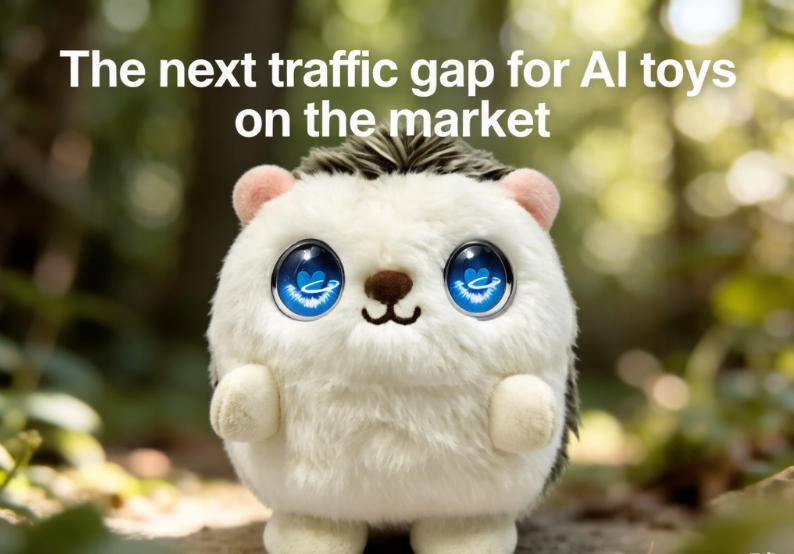
Recently, there has been a subtle yet significant change occurring in our backend private messaging and business collaboration groups.
If you observe carefully, you will notice an interesting phenomenon: an increasing number of business contacts who have never had any interaction before are entering our sight in an almost “straightforward” manner. Among them are cross-border e-commerce sellers with a wide range of products, seasoned channel veterans who have deeply penetrated offline supermarkets, astute selection managers, and entrepreneurs seeking new market segments for transformation.
They often omit the lengthy greetings and self-introductions, and even have no time to exchange business cards. The first sentence they utter is astonishingly consistent: “Do you have AI toys?”
This unadorned directness conveys a sense of urgent desire. Initially, we thought this was just an isolated phenomenon, but as similar inquiries became more frequent at an exponential rate, a clear signal emerged: This is no coincidence; it is a well-planned channel migration.
I. The “Hunting Instinct” of Channels: Searching for Increment in the Existing Stock
For any experienced channel operator, they often possess an animal-like acute intuition. They understand that when the profit period of a category has passed and the products enter an endless internal competition and homogenization, it is the precursor to profit depletion. At this time, finding new “prey” – that is, new categories – becomes the only rule for survival.
Looking back at the history of consumer electronics and department store channels in the past few years, you will find that this is almost a cycle:At one time, everyone was frantically searching for camping products, which was the peak period of the outdoor economy;Then, stress toys became popular, which was an outlet for emotional consumption;Later, pop-up toy boxes swept the country, which was a carnival of IP and surprise economy.
Each transition was essentially the channel searching for a new story, seeking a “catfish” that could re-activate dormant traffic. Now, this highly anticipated keyword is converging from the vague “novelty” to a specific technical term – AI.
II. The “Traffic Magnetic Field” Built-in by AI: The Precious Commodity in the Content Era
In the current business context, AI is not merely a technology; it is also a highly magical form of traffic currency.
Even though many channel providers do not fully understand the Transformer architecture or the training principles of large models, they have, based on their years of market acumen, accurately grasped a fact: as long as the product prefix includes “AI”, it inherently possesses the genes for dissemination.
For content creators, the word “AI” is the traffic code for the title. An article titled “This Cat Can Chat” is far less eye-catching than “This AI Cat Understands My Emotions”. For live-streaming sales hosts, a toy that can recite Tang poetry is ordinary, but an AI doll that can interact in real time based on the chat box and even “retort” can instantly create the plot tension of the entire live-streaming show. For selection experts, what they have been desperately seeking is precisely this kind of product that has both a physical grip and a virtual imaginative space.
AI toys perfectly fit this demand: they can be described as “a chat partner”, “an emotional confidant”, “a growing playmate”. These labels are naturally suitable for the fragmentation dissemination of short videos and live-streaming. This “light hardware + heavy AI” model greatly avoids the cost risks brought about by the increase in storage prices. In the current situation of fluctuating hardware costs, this high value-added and low hardware dependence product form has naturally become the “risk-averse asset” in the eyes of channel providers.
III. The Pressure of Reality and the Solution of Lightness
Apart from the desire for growth, there is also an extremely realistic and cruel business factor that is forcing channel transformation – the drastic fluctuations in hardware costs.
Recently, the global storage market has undergone sudden changes. Whether it is NAND Flash or DRAM, prices are experiencing a sharp upward trend. For traditional intelligent hardware, this means the uncontrollable BOM (Bill of Materials) costs and further compression of profit margins.
However, the emergence of AI toys provides a highly intelligent “lightweight” solution. Thanks to the progress of cloud computing and edge computing, AI toys no longer need to pile up expensive local computing chips like traditional hosts. Many complex AI capabilities, such as natural language processing, image recognition, and long-term memory, can be migrated to the cloud for completion.
The local hardware only needs to retain the most basic “sensory” and “expression” capabilities – a microphone for recording, a speaker for sound output, and a simple motor control system for body movements. This “light hardware + heavy AI” model greatly avoids the cost risks brought about by the increase in storage prices. In the current situation of fluctuating hardware costs, this high value-added and low hardware dependence product form has naturally become the “risk-averse asset” in the eyes of channel providers.
IV. Prudent Exploration and Positive Signals
Of course, we must objectively see that the current AI toy market is still in a “warring era”. Truly bestseller products that have undergone long-term market tests and formed a national consensus are actually still rare.
Therefore, the intensive inquiries from distributors at present are largely a “strategic exploration”. They are not blindly preparing to place huge orders, but are carefully verifying several core assumptions: Will users be willing to hold it for a long time, rather than just “become useless”? Is the AI interaction experience smooth enough to retain users? Can the product’s yield rate and stability withstand the test of large-scale production?
These questions are the difficult problems that the entire industry is working together to solve. But more important than the problems themselves is the change in the questioning method.
Just a few months ago, the common questions we received were: “What exactly is an AI toy?” “Does this thing really have buyers?” “Will this just be a hype concept?”
Now, the subject of the questions has changed from “concept” to “physical object”. People no longer question its existence, but directly ask about its availability. This change from “what is it” to “is it available” is only one word different, but reflects a fundamental reversal in market mentality: Skepticism is fading, and pragmatic exploration is becoming the mainstream.
V. Conclusion: The Beginning of the Search, is the Prelude to the Outbreak
Every major transformation in business history does not start with earth-shattering bestseller, but with the silent search of various market forces.
When suppliers start to refine products, when distributors start to actively search, and when consumers start to eagerly await, an industrial closed loop has quietly formed. Now, we are standing at the starting point of this closed loop. More and more people are, through different paths, seeking the same answer – that AI toy that can truly enter thousands of households.
This search about the future has just begun. But it can be predicted that whoever finds that “there is” first will have the ticket to enter the next era.