


Blog
When AI toys evolve from “adorable ornaments” to “spiritual substitutes”

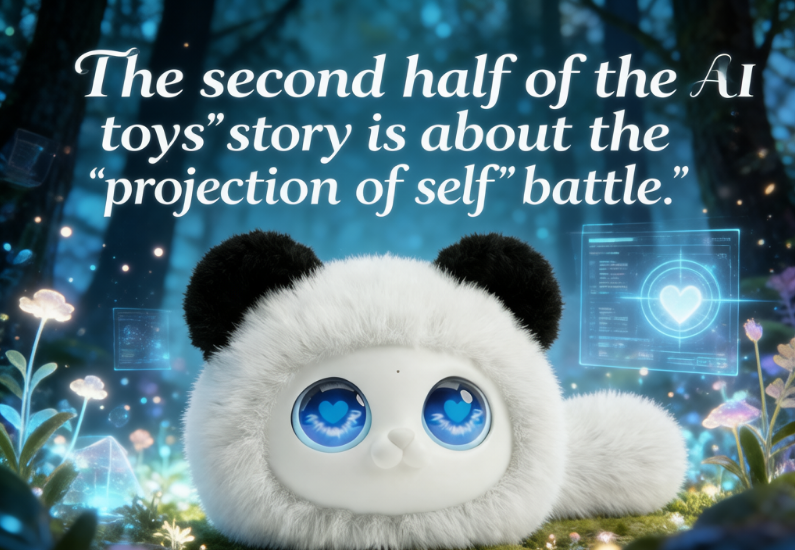
Over the past two years, the AI toy sector has been extremely popular, with a flood of capital and a continuous stream of products. However, beneath this prosperous appearance lies an extremely high failure rate. We have seen too many such products: they have exquisite features, are equipped with the latest large models, can recite encyclopedias, can tell captivating stories, and can have coherent conversations for several hours. But, three months after their launch, most of them quietly lie on second-hand trading platforms being sold at discounted prices, or accumulate dust on users’ bookshelves.
Faced with poor sales and abandonment, the R&D teams often tend to attribute the problem inwardly: are the parameters of the large models not large enough? Is the cost of voice synthesis not reduced? Is the market education for consumers not yet adequate? These technical reflections are undoubtedly important, but they conceal a more essential and fatal strategic blind spot: what you have made might be a “lovely IP”, but not a “reducible IP”.
I. The Lonely Spectator: When “Cute” Loses Its Impact
In the current AI toy market, there is a kind of “exquisite mediocrity”. Most products, at the beginning of their design, have fallen into a pathological pursuit of “cute”. Designers repeatedly refine smooth lines, harmless color schemes, and soothing expressions, attempting to create a visual sense of pleasure. Functionally, they integrate voice interaction, story generation, and knowledge answering, appearing to be omnipotent.
However, the real feedback from users is chillingly indifferent: “It’s quite interesting.” “It’s quite cute.” Then, there is no “then”.
The root cause of this indifference lies in the fact that there is an invisible glass wall between the user and the product. The user stands outside the wall, observing this “cute” creature like in a zoo, but without any impulse to climb over the wall and become a part of it. The problem is that users cannot “become it”. When a product can only be “watched” rather than “substituted”, it is destined to be a temporary visitor rather than a permanent resident of life.
II. The Battle of Two IPs: From “Being Liked” to “Being Recognized”
To understand this phenomenon, we need to divide IPs into two completely different dimensions.
One is the “lovely IP”. The typical feature of this type of IP is being beautiful, being soothing, and being safe. They are like dolls in the display window, flawless and endearing. When users see them, their reaction is: “So cute.” But behind this compliment lies a fatal flaw – it is merely being seen, not being needed. It lacks the touchpoints that can generate a chemical reaction with the user’s real life and cannot occupy a place in the user’s emotional map.
The other is the “emotional substitution IP”. This type of IP is often less perfect. They have states, emotions, and even a bit of “dejection”. When users see them, their reaction is often: “This is me!” This strong sense of déjà vu instantly breaks through the psychological defense. Then, two crucial things happen: users are willing to pay for it because they are buying their reflection; users are willing to use it repeatedly because they are having a conversation with another “self”. For AI toys, without this deep substitution, there is no stable emotional relationship; and without the relationship, no matter how powerful the AI’s computing power or how rich the language data, it is just a pile of scrap metal.
III. Why “Sad Culture” Has Become the Traffic Secret?
Interestingly, while many teams are still obsessed with creating sunny, positive, and healing “perfect idols”, the market gives a completely opposite feedback. Those characters with a sad face, a defeated posture, and shouting “Don’t want to work” are, instead, more likely to ignite social networks.
There are profound psychological reasons behind this. In this performance-oriented social media era, positive emotions can be faked. The “happiness”, “positivity”, and “effort” we show in our social media circles are often a kind of social mask. However, negative emotions – internal strain, breakdown, and a sense of powerlessness – are difficult to fake. They are extremely real vulnerabilities. When an AI character openly shows these “imperfections” and says “I really don’t want to strive anymore”, users will experience an unprecedented sense of relief: “Finally, someone has spoken my mind for me.”
This authenticity builds a strong emotional connection. Imagine that when you post a “Today I’m happy” update, you might only receive polite likes; but when you share an AI character emoji pack with “battery depleted”, the comment section often turns into a large-scale “lie down” scene. This is the underlying logic of the emotional IP: it doesn’t need to make people think it’s great, it just needs to make people feel “you are me”. This resonance is the original driving force of social viral spread.
IV. The “Iron Triangle” Structure of Emotional IP
An AI toy IP that can truly take off must have the following three core structures, all indispensable.
Firstly, it has “eye-catching” emotional expression ability. In an era of information overload, users’ patience is measured in seconds. A qualified AI character must allow users to understand its current emotional state within one second, simply through a glance or a posture. If it also requires a thick manual to explain the world view and background settings, then this IP has already lost from the start.
Secondly, it has “blank space” for imagination. Many creators tend to make a mistake: setting the character too fully. Too complex backgrounds, too complete personalities, and too grand worldviews will instead squeeze the user’s imagination space. Excellent emotional IPs are often “half-empty”, like a blank container, inviting users to fill in their emotions, memories, and personalities to complete the shaping of this character.
Finally, and most importantly, it has “usable” tool attributes. If an AI toy can only be placed on the table quietly, then it is ultimately just a high-end decorative item. A true emotional IP must become an “expression tool”. Can it be screenshot and shared on social media? Can it be used as a social currency in chats? Can it become a synonym for users to express “I’m tired” or “I’m annoyed”? Only when the AI toy evolves from “being watched” to “being used” can it rise from a simple toy to a user’s emotional interface.
V. The Ultimate Mission of AI: The Creator of Relationships
In the wrong perception, the role of AI is to make toys smarter, able to answer more difficult questions, and able to execute more complex instructions. But in the correct logic, the sole mission of AI is to “make the relationship hold”.
Users don’t care about how intelligent the AI is; what they really care about is: does this character remember what I said yesterday? Does it understand the pain behind my forced laughter? Does it show me a little unique favor? The core value of AI in this industry does not lie in providing standard answers, but in providing a sense of being understood and accepted. This determined relationship is the soul of the AI toy.
VI. Industry Divide: The Battle between Hardware Factory and Emotional Company
Looking forward to the future, the dividing line of the AI toy industry will be extremely clear. The market will rapidly split into two completely different types of companies.
One is the hardware company. They are good at assembling plush fabric with AI modules, competing for costs in the red sea and squeezing profits on the supply chain. Their ultimate goal is to produce generation after generation of “toys with chips”, falling into endless homogeneous competition.
The other is the emotional IP company. They focus on polishing emotional tags, deepening the role’s sense of immersion, and managing long-term user relationships. What they sell is no longer cold hardware, but the emotional projection and continuous interactive services of users. Such companies no longer rely on a single sale, but obtain high premiums through repeat purchases, subscriptions, and content updates.
Although both produce “toys”, their business logics are completely different. The moat of the former is scale and efficiency, while that of the latter is emotion and data. The real threshold is not in the chips or the code, but in that soul-searching question: Can your role allow users to put themselves into it?
VII. Conclusion: Three Questions Determine Survival
For every practitioner in this field, in the future, when evaluating any product, simply ask yourself three questions, and you can predict its survival or failure:
First, can users understand its emotions at a glance? If not, it loses the viral gene for dissemination.
Second, can users put themselves into it? If not, it cannot trigger the original impulse for purchase.
Third, will users actively seek it at certain specific moments? If not, it will never acquire high-frequency usage stickiness.
If these three points do not hold, then no matter how dazzling the AI technology is, it is just an emperor’s new clothes, a self-deceiving technological gimmick. The future winners will definitely be those who understand to give up the obsession with “perfection” and embrace the real, vulnerable and resonant emotions of the emotion hunters. Because what people love is never that perfect machine, but the imperfect self they see in the machine.