


Blog
When “role” takes the place of “tool”, AI toys are reshaping an era

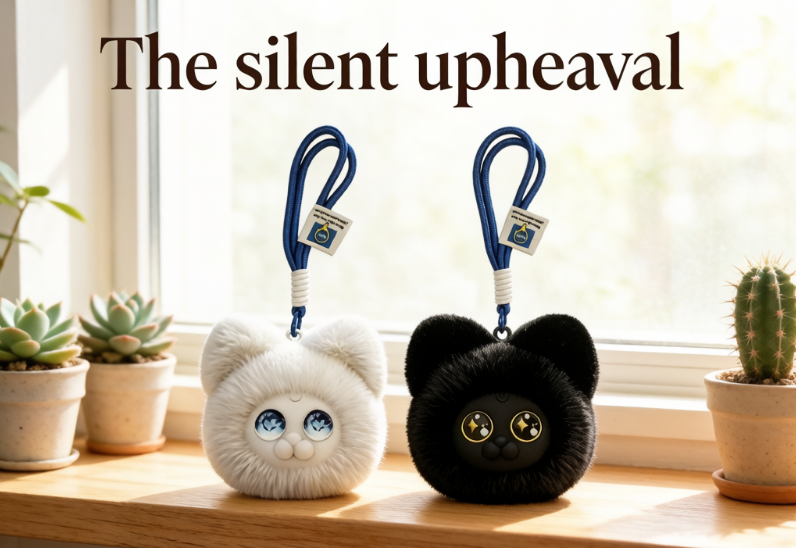
The wheels of history roll forward, but the changes in industries often do not occur with a grand bell toll, but quietly. Very often, the birth of an industry does not have an official announcement or a ribbon-cutting ceremony. Until one day, you suddenly look up and find that everyone around you is talking about the same model, is tackling the same problem, and is heading in the same direction. After the Spring Festival in 2026, this feeling was particularly strong – AI toys were gradually coalescing into a real industry.
Looking back over the past year, AI was undoubtedly a highly sought-after star. The capabilities of large models were astonishing, various tools were emerging one after another, and the application layer seemed to be blooming with diversity. However, when we strip away the media’s hubbub and return to the ordinary lives of ordinary people, we discover an embarrassing fact: the AI products that truly enable us to continuously use and develop a dependence actually are very few. Most applications are like fireworks, dazzling for a moment and then fading into silence.
But in this silence, a brand-new form is quietly growing: AI companions. When the cold big model technology is integrated into the warm plush toys, everything suddenly becomes concrete and vivid. A toy is no longer just a plastic product produced on an assembly line; it is endowed with digital life: it can talk to you, the tone is no longer harsh; it can remember your preferences and the secrets you said last time; it can sense your emotions and offer clumsy but sincere comfort when you are sad; it can even “grow” and evolve into a unique personality based on your interactions.
Many people suddenly realized for the first time: perhaps the most natural and perfect form of AI is not the cold and efficient tool, but a flesh-and-blood “character”.
I. Reconfiguration of the industrial chain: From “one-off transaction” to “long-term relationship”
This cognitive shift is triggering a geological movement in the toy industry. The traditional toy industry is essentially a purely manufacturing industry. Its logical chain is linear: design, prototyping, production, distribution channels, sales. Once the product is handed over to consumers, the connection between the manufacturer and the user is basically cut off, with only after-sales maintenance remaining.
But AI toys have completely shattered this chain. AI has given toys the ability to “exist continuously”. It is like a mobile phone system that updates, like a friend that learns, like a pet that changes. Thus, toys have transformed from a one-time commodity into a long-term experience and service.
This is an extremely profound industry transformation: Toys have become “online”. In the past, only online game characters, virtual idols, and social accounts were online, they were residents of the digital world. And in the future, physical toys will also be connected to the cloud and become a new terminal of the Internet. This means that every toy placed on the bedside table could become a huge IP entry point.
II. The birthplace of the next generation of IP: From “watching” to “getting along”
Looking back over the past two decades, the birthplace of super IPs was very concentrated: Hollywood’s film and television blockbusters, Nintendo’s games, and Japanese anime. But in the future, this list will add a powerful competitor: AI toy companies. Why? Because only AI toys possess the three core elements that make them top-level IPs: distinct characters, real-time interaction, and long-term companionship.
Imagine that a child may not watch cartoons on TV every day, but he is likely to hold his AI doll and talk to it every day. When this high-frequency and deep interaction relationship is formed, the logic of the IP is completely rewritten. Traditional IPs are “watched”, with the audience being spectators; while the IP of AI toys is “shared”, with the user being the participant. This will give rise to a completely different type of IP company – they are more like a combination of psychological research companies and scriptwriting studios.
III. 2026: The Year of the Birth of AI Toys
We judge that 2026 is very likely to be the year of the birth of AI toys. Because all the conditions that support the explosion of this industry are simultaneously converging:
Technically, the capabilities of large models are already sufficient to support complex emotional conversations, and the naturalness of voice interaction makes it difficult for ordinary people to distinguish; on the supply chain, hardware costs are dropping significantly, making it possible for AI toys to enter middle-class families; on the content side, the explosion of AIGC (AI-generated content) has made personalized character settings cheap and efficient.
More importantly, there is a dramatic change on the demand side. The younger generation, especially the Z generation, has an unprecedentedly strong demand for “emotional products”. In this atomized society, companionship, expression, and emotional connection have become luxuries. These things were difficult to be carried by physical products in the past, but now, AI can do it.
So we see that in the past six months, various heroes and heroes have entered the game one after another. Some teams are making AI plush toys, focusing on warmth and healing; some are making AI tabletop pets, focusing on cyberpunk; some are creating AI character IPs, trying to create the next Linna Belle; and some are making AI companion hardware, trying to replace mobile phones. Although the entry points are scattered, they all lead to the same destination – a brand-new industry is taking shape.
IV. Order in Chaos: The Early Appearance of a New Industry
Of course, if you look deeply into this industry now, what you will see is definitely chaos. The products are not yet mature, the interaction still has delays, and the business model has not yet been implemented. But this is a necessary stage for all new industries.
Recall when Taobao first emerged, no one thought it could shake the department stores; when Douyin was launched, no one believed it could eat up users’ fragmented time. Many things only become clear when looked back. Maybe in a few years, people will find that those future dominant AI toy giants were sowing the seeds in this stage.
V. What is the essence of competition?
For entrepreneurs in this industry, the most suitable question to think about is: What exactly is the core competitive barrier of AI toys?
Many people mistakenly believe it is technology, chips, or algorithms. But it’s not all. Technology will eventually be universalized. When large models and hardware modules become as easy to obtain as screws, what will really set the gap apart is “soft power”:
Character ability: Can you create a character that makes people fall in love at first sight?
Content ability: Can you continuously produce interesting stories and interactions?
Worldview ability: Can you build a universe that users believe in deeply?
Emotional understanding ability: Can you accurately capture even the slightest emotional fluctuations of users?
In other words, in the future, toy companies will increasingly resemble a content company or a talent agency. Who can create a character that is loved by the masses, who will have the traffic code of this era.
If you are making AI toys, today you might want to re-examine your product: Are you creating an ice-cold electronic product, or a character with warmth? Does it have a unique personality? Does it have memorable points? Does it have reasons for users to want to talk to it the next day? These things are perhaps far more important than the manufacturing process of the chips, the capacity of the batteries, or the stacking of parameters. Because the future users will remember not which processor you used, but the character who accompanied her in the dead of night and understood her thoughts.
On this morning, in countless offices, computer screens lit up one by one, design drafts were reopened, models began to rumble, and prototypes were being sampled. There was no noise, only the sound of keyboards being tapped. A brand-new industry was officially born in the midst of these lit-up lights.