


Blog
The knockout stage has arrived: As AI toys shift from being “reasonably priced” to “unprofitable to sell”

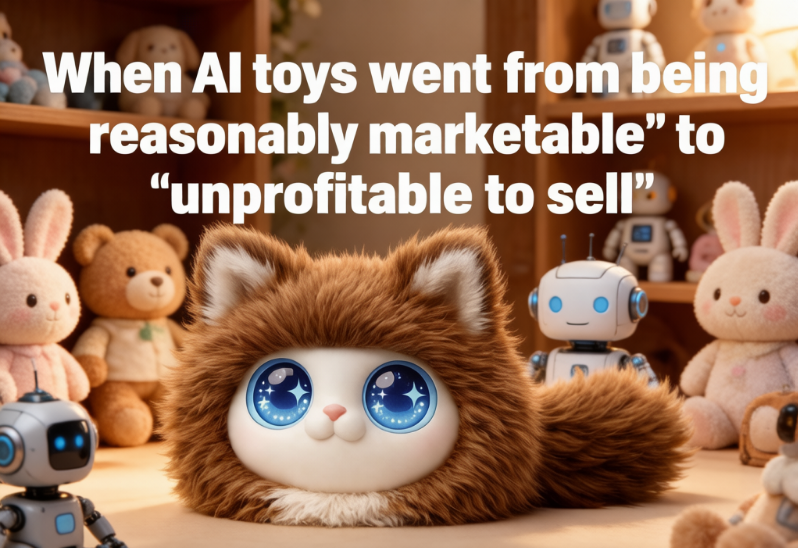
In 2025, AI toys were a “anyone could say a few words” industry. In the Huaqiangbei area of Shenzhen, the entrepreneurship park in Hangzhou, and even in coffee shops in Beijing, the narratives about AI toys were rampant. Factory owners confidently claimed they could handle the supply chain, serial entrepreneurs passionately discussed the implementation of large models, IP teams were busy seeking technological integration, and even those who had never touched circuit boards could confidently talk about “emotional value” and “companionship economy” in front of a PowerPoint presentation. It was a golden age where as long as you labeled it with “AI”, you could attract investment, and as long as you produced a demo that could speak, you could participate in a crowdfunding round.
However, when the clock turned to 2026, a silent and cruel change was taking place. The industry did not completely “cool down” as some pessimistic remarks suggested, but a number of once-booming projects had quietly died. Some died due to mountains of inventory in warehouses and sporadic orders, some due to appalling repeat purchase data – the products that sold their first order were abandoned by users within less than two weeks in their hands; some were more concealed, and they were even maintaining the illusion of “normal operation”, with factories still operating and teams still receiving salaries, but everyone knew that it was just a last gasp before death.
I. The bankruptcy of narratives: When “it makes sense” meets “it doesn’t sell”
It is undeniable that the market base of AI toys has been growing in the past year. Users are indeed trying, capital is indeed observing, and large companies are indeed entering the game. But the underlying logic of the industry has undergone a crucial turning point: from “it makes sense” to “it needs to sell”.
In 2025, you only needed to answer one philosophical question: “What is an AI toy?” – A chat partner, a storytelling teacher, an emotional trash can. This answer was enough to impress investors and support a press conference. But in 2026, the market only cared about three extremely realistic commercial questions: Can it be sold? To whom? Where is the repeat purchase?
It was at this cruel turning point that the first batch of survivors began to run aground. They discovered that no matter how compelling the story was, it could not hide the embarrassment of unsold goods; no matter how hot the concept was, it could not fill the deep pit of zero repeat purchase rates.
II. The first type of cause of death: “AI Function Patch” toys
This was the first batch to fall. Their logic was simple and brutal: in an ordinary plush toy or plastic model, insert a voice module and Wi-Fi chip, connect to a general large model, and then call it “AI companionship”.
The biggest tragedy of these products lies in their confusion of “function” and “relationship”. Users never want a “toy that can talk”, they want a “role that can create emotional connections”. Reality dealt them a heavy blow: due to network latency and model hallucinations, the conversation experience is extremely unstable; due to the lack of a long-term memory mechanism, each chat is like meeting for the first time, and the conversation ends as soon as it is over; more fatally, due to the lack of a distinct personality setting, the AI’s responses often resemble cold customer service rather than a warm friend. The problem with these products is not that the AI is not strong enough, but that they only have “function” and no “character”. Users quickly got tired of that electronic pet that could only recite Tang poems and tell cold jokes.
III. The second type of cause of death: “Fake Education” AI toys
The most easily understandable track in 2025 was “AI + learning + companionship”. It sounded perfect: it could both educate and entertain, and solve parents’ anxiety. But the market’s feedback was extremely direct: it was not enough for learning, nor was it enough for fun.
The logic behind users’ choices is quite clear: If parents truly value the learning outcome, they will not hesitate to purchase professional learning machines or tablets, as these devices have a systematic curriculum; if the child only wants to play, parents will buy pure trendy toys or game consoles. However, these “pseudo-educational” products are awkwardly stuck in the middle: they are sold at the price of educational products, but offer the experience of toys. As a result, they fail to please both ends – parents are dissatisfied because they think it doesn’t provide any learning, and the child is unhappy because it doesn’t offer enough fun to play.
IV. The fourth type of cause: “The naked runners without IP”
This was the most obvious elimination round in 2026. Over the past year, a large number of products had similar appearances: a randomly generated animal image, a casually chosen English name, along with a bunch of AI functions, and then rushed to be launched.
The problem is that humans won’t establish emotional connections with a strange “thing”, but will only invest genuine feelings in a “character” with a story. Without an IP, it means there are no memory points, users can’t remember it; without transmissibility, users don’t want to share it; without a repurchase rate, users discard it after using it once. The harsh reality of the market reveals: selling one order doesn’t mean it can become a product; becoming a product doesn’t mean it can become a brand. Those soulless piles of code will eventually be forgotten in the corner of the shelves.
V. The fifth type of cause: “Hardware obsessive” chronic blood loss
This type of failure is often overlooked because it doesn’t die violently enough, but rather like a chronic disease, slowly “bleeding”. Such teams usually have strong factory capabilities, exquisite prototyping techniques, and deep supply chain advantages. They can produce high-quality hardware, but they are lacking in one of the most crucial things: content capabilities.
The essence of AI toys is undergoing a dramatic change: it is evolving from a “hardware product” to a “content carrier”. Without continuous updated content, without carefully designed interactive plots, without deeply touching character settings, the hardware is just an empty shell. The resulting outcome is: the first order may sell well due to novelty, but due to the lack of continuous interaction, the user relationship cannot be established, the product lifecycle is extremely short, and the repurchase rate quickly drops to zero. Eventually, the factory shuts down, inventory piles up, and the team dissolves in silence.
VI. The cognitive gap: AI is an amplifier, not a savior
If all these failure cases are analyzed together, a common lesion is found: they all regarded AI as the “selling point” itself. As if adding AI to the toy would have the magic of turning stones into gold.
But starting from 2026, a clearer consensus is emerging: AI is not the product, but an amplifier. It can amplify the charm of a good product, and also amplify the flaws of a bad product. The truly successful projects start to have the following characteristics: having extremely clear vertical audiences (such as “a bedtime companion for anxious girls aged 6-8”), rather than trying to please everyone; having a distinct and consistent “character personality”, rather than just a good appearance; providing deep “emotional value”, rather than shallow “functional selling points”; being able to achieve “continuous interaction”, rather than one-time experiences.
In other words, AI technology can make toys “more like people”, but what determines whether it can survive is “what kind of person it is” – is it the friend who silently accompanies you when you are sad, or the machine that just repeats mechanically?
VII. The migration of thresholds: The old map can’t find the new continent
At this point, many practitioners inevitably feel anxious: Can we still make AI toys now?A more accurate question should be: Are you using “last year’s methods” to make this year’s products?
The players who remained in 2026 have already started to do several completely different things: They are conducting extreme “audience segmentation”, refusing to make large and all-inclusive mass products; They are meticulously crafting “IP personality”, rather than just stopping at appearance design; They are deeply “scene-bound”, integrating the products into specific life slices of users (such as “an emotional trash can on the way to work”); they are precisely “channel-matched”, customizing the products based on the characteristics of the channels rather than creating the products first and then finding a market.
The conclusion is: It can be done, but the threshold has changed. The era where a start-up could raise tens of millions with just one demo has come to an end.
VIII. Conclusion: Cooling down is for healthier growth
Many people ask: Are AI toys no longer viable?
My answer is: It’s not that they are no longer viable, but that “the era when it was easy to do it has ended”.
In 2025, it will be a celebration of “anyone can enter”; starting from 2026, it will become “only those who truly make products will have the chance to stay”. The so-called “cooling down” you see now is essentially a healthy adjustment of the industry from “emotion-driven” to “result-driven”. The bubbles are squeezed out, and the good and bad are mixed together. What remains is the gold. This might be a more healthy stage because it forces practitioners to return to the essence of business – creating value, rather than fabricating concepts. For those “craftsmen” who truly understand users, content, and relationships, spring has just begun.