


Blog
When AI steps beyond the screen, who is shaping the ultimate relationship between humans and machines?

If we take a broader view and look at the overall picture of the AI industry from 2025 to 2026, we will notice a highly ironic dissonance. On the left side of the stage, the large model arms race is still in full swing, with parameter quantities, inference speeds, and release schedules all constantly breaking records, and the technical curve is so steep that it is almost suffocating. However, on the right side of the stage, the real industrial implementation end is permeated with a calm anxiety. Whether it’s manufacturing veterans or consumer product operators, they no longer blindly worship the soaring parameters, but repeatedly ask a simple question: What specific uses can these powerful capabilities have?
When “stronger” no longer automatically equals “useful”, AI must undergo a painful transformation. It must leave the comfortable laboratory, break free from the constraints of code, and dive headfirst into the chaotic, trivial, and full of uncertainty real world. And this grand narrative’s opening does not occur in the cyber city of a science fiction movie, but in the most familiar and tender domain – at home.
Looking back over the past half century, the evolution logic of household appliances has always remained at the level of “instrumental rationality”, the core being how to execute human instructions more efficiently. Even with the addition of voice control, it is essentially just replacing “pressing buttons with fingers” with “pressing buttons with the mouth”. But at the AWE exhibition in 2026, leading enterprises like Hisense are attempting to rewrite this underlying logic. They are no longer showing “more obedient” devices, but starting to try “understanding people” systems. True understanding is not simple voice recognition, but the device can sense your homecoming time, understand your physical condition, and even understand the underlying motives behind your command. Thus, a subtle but decisive change has occurred: You no longer need to operate the device, the device begins to make decisions for you. The air conditioner becomes the steward of the environment, the refrigerator becomes the advisor for meals, and they are evolving from cold “tools” to “life agents” of the family.
Behind this evolution is the birth of “physical AI”. The past AI, no matter how eloquent, was always trapped at the “brain” level and could not change a single dust in the physical world. But the emerging physical AI is equipping the digital brain with limbs. When the perception layer composed of sensors, the decision-making layer composed of models, and the execution layer composed of hardware are connected, AI truly acquires the ability to act. The TV is no longer just a display screen for one-way information dissemination, and the vacuum cleaner robot is no longer just a random-acting vacuum cleaner. They begin to intervene physically and optimize our living environment. This is a crucial step for AI to move from the “virtual altar” to the “humanity and warmth” of the real world.
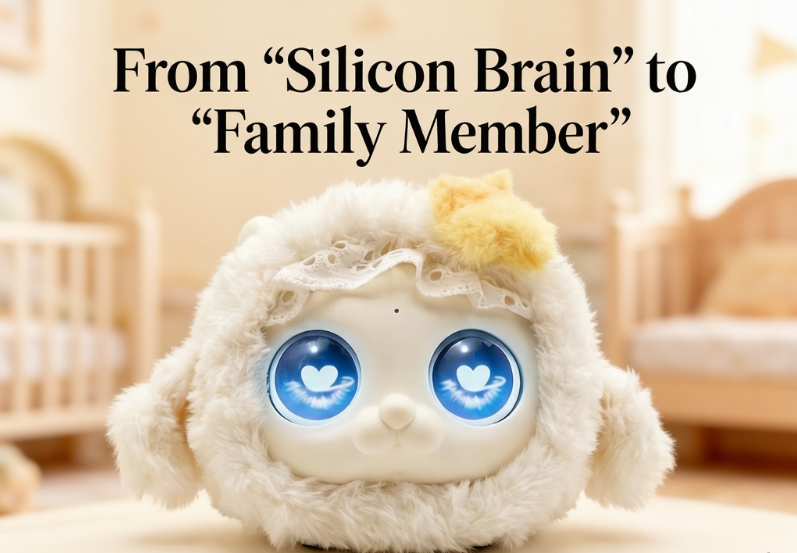
However, if our observation stops at the intelligence of household appliances, what we see is merely “better machines”. The truly profound transformation occurs in the seemingly marginal but actually core field of AI toys. Household appliances pursue efficiency and convenience, while AI toys pursue connection and resonance. Traditional toys are static “content carriers”, even early AI toys mostly remained at the stage of “speakable dolls”. But when large models have acquired long-term memory and multimodal understanding capabilities, a qualitative change occurred. AI toys no longer wait to be triggered, but start to “exist actively”. It remembers the troubles you mentioned last week, it can detect your depression when you are silent, and it will greet you actively when you don’t speak. At this point, it is no longer a device, but more like a character, even a relied-upon “person”.
If we re-examine the structure of the future family, we will find a stable triangle forming. The household appliance system is responsible for maintaining the comfort and order of the physical environment, solving the “quality of life” problem; the AI system is responsible for scheduling and optimization, solving the “resource allocation” problem; and the AI toys are responsible for receiving the emotional flow of family members, solving the “happiness” problem. Imagine such a scene: After a long and exhausting day at work, you push open the door of your home. The air conditioner has adjusted the room temperature to the most suitable level. Soft lighting and music automatically turn on. At this moment, the AI plush toy placed at the entrance lifts its head and uses its characteristic tone to inquire about your condition with concern. The technical difficulty of this sentence might be much lower than making a robot do a backflip, but its value is immeasurable because it reaches the human heart, rather than just meeting human needs.
The history of technology has repeatedly verified a rule: Truly great technologies will eventually “disappear”. Electricity disappears in sockets, the internet disappears in apps, and the future AI will disappear in ubiquitous services. But this “disappearance” is unfolding along two completely different paths. In the field of household appliances, AI will become air, temperature, and cleanliness, becoming an invisible guardian; while in the field of AI toys, AI will become memory, conversation, and companionship, becoming an explicit companion. These two paths will eventually converge at a point: AI will no longer be a cold tool, but a “role” in the family.
If you were to ask which category of product is closer to the final form of AI, the answer might not be the most powerful supercomputer, nor the most functional smart home, but the one that is closest to “humanity”. Home appliance companies are striving to make machines “understand humans better”, which is the prelude to AI entering reality; while AI toy companies are attempting to make machines “become human” – at least becoming an object of emotional projection. When household appliances start to understand your temperature preferences, it’s a small step for AI; when AI toys start to understand your joys and sorrows, it’s a major step in this transformation. Someday in the future, perhaps we won’t care about the size of the model used by this AI or the speed of the chip it runs on; we will only care: Did it remember my birthday today? Did it quietly stay by my side when I was down? At that moment, AI has truly made the risky leap from “technology” to “existence”. And we are witnessing the beginning of this leap.