


Blog
Channel Breakthrough: How Can AI Toys Move From “Exhibition Phenomenon” to “Mass Consumption”?

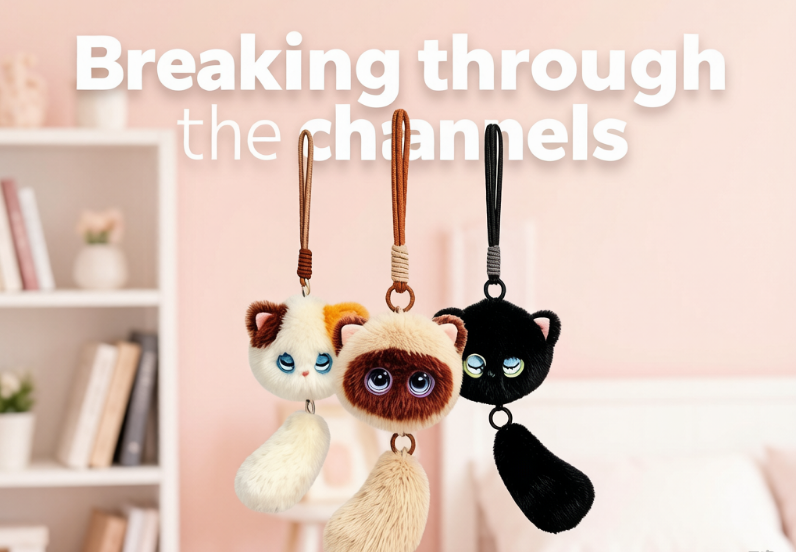
Over the past year, AI toys have made a dramatic leap from a PPT concept to an actual product. However, when viewed from the broad perspective of industrial development, this is merely the beginning. The current AI toy industry is like a wild and untamed land that has just undergone crustal movement: product forms are exploring in the fog, business models are testing and failing, and the most crucial aspect – sales channels – only shows some signs of new life in the ruins.
But in the past few months, the “ground-level” influence from the market has begun to warm up and become real. During the Spring Festival in 2026, the sales curve of AI toys suddenly rose sharply, no longer a gradual growth, but an explosive leap; in the Yiwu International Trade City, which is hailed as the “world supermarket”, the selection heat for AI interactive toys soared sharply, and the air was filled with the anxiety and excitement of traders snapping up goods; even more intriguingly, a group of astute entrepreneurs began to open independent AI play experience spaces in first-tier cities’ high-end shopping malls.
These seemingly isolated signals actually point to the establishment of the same business logic: The sales channels of AI toys are moving away from the early scattered exploration and moving towards the preliminary formation of systematization and three-dimensionality. This is the inevitable path for an industry to mature.
In the traditional toy industry, sales channels are solid fortresses that have long been fixed: Walmart, Toys “R” Us, large supermarkets, corner mom-and-pop stores, or school stationery stores. These channels rely on foot traffic, shelf display, and brand momentum. However, the emergence of AI toys is like a stone dropped into a calm lake, breaking this stagnant water. It has completely different consumption characteristics – it cannot be simply “seen”, it must be “felt”; it cannot be moved emotionally by the selling points on the packaging box alone, it must be “interacted”. Therefore, the old channel logic has failed, and new circulation paths are being painstakingly and firmly opened.
I. Experience-based Retail: Making the “Soul” Visible
The biggest commercial barrier and the biggest sales difficulty for AI toys lie in their core value – “interaction” is intangible. A child can have a half-hour deep conversation with the toy, listen to it tell bedtime stories, engage in wild questions and answers, but these exquisite experiences cannot be printed on the back of the packaging box.
For this reason, experience-based retail has become the first sharp tool to break through. Some highly forward-thinking merchants have begun to liberate AI toys from the closed counters and place them in open experience scenarios. Whether in the children’s technology experience zone set up in the atrium of a bustling shopping mall, or the toy collection store specializing in black technology, or the AI interactive flagship store operated by the brand, their core logic is only one: Let consumers try first, then pay.
This sales path is similar to the process of DJI (DJI) promoting consumer-grade drones in that era. Without establishing “flagship experience stores” and “authorized experience centers” worldwide, allowing users to fly the drones themselves and experience the shock of the god’s perspective, there could not have been the subsequent industry dominance. For AI toys, this “experience-based retail collection store” is not only a sales channel, but also a base for user education and the most important offline traffic entry point in the future.
II. Children’s Growth and Education Scenarios: Trust as a Guarantee
If the shopping mall experience stores bet on “novelty”, then the education scenarios bet on “necessity”.
AI toys inherently possess a dual gene: They are both toys and teaching aids. Compared to ordinary toys that can only launch rubber bands, AI toys have hard-core functions such as storytelling, encyclopedia question answering, English oral practice, and scenario simulation. These functions make it naturally open the doors of early education centers, children’s programming clubs, picture book libraries, and various parent-child activity venues. For educational institutions, AI toys are no longer merely a commodity for sale; they have transformed into an extremely attractive interactive teaching tool. Teachers can use it to assist in teaching, and children have no resistance to it. For parents, the purchasing decisions made in educational scenarios are often more rational and generous than those made in shopping malls. When salespeople tell them, “This toy not only entertains your child but also teaches him English and develops his expression skills,” parents are more willing to pay a premium for this “companionship + inspiration” dual value. The deepening of this channel will provide a continuous stable driving force for the AI toy market.
III. Content-driven E-commerce: The Magic of Seeing What You Get
Online, the sales logic of AI toys has also undergone a genetic mutation.
In the traditional Taobao and JD models, toys rely on exquisite still-life photography and detailed graphic detail pages. But on content platforms such as Douyin and Xiaohongshu, AI toys have found their “native language”. Short videos and live streaming allow the interactive capabilities of AI toys to be presented without loss. When the influencers in front of the camera demonstrate how the toy can cleverly answer tricky questions, how it can vividly tell stories, and how it can imitate the tone of cartoon characters, the viewers on the screen are instantly “converted”.
This “content-based display” has a natural viral dissemination effect. Because the interaction process itself is a dramatic conflict, it is the source of the content. Compared to static images, dynamic conversations can better stimulate users’ empathy and desire to own. This also means that future AI toy marketing will no longer solely rely on brand advertising but increasingly rely on the real experience sharing of KOLs (Key Opinion Leaders) and KOCs (Key Opinion Consumers). Content creators are becoming an indispensable key link in the circulation chain of AI toys.
IV. Changes in Consumption Philosophy Behind the Channels
Peeling back the surface of the channels, we see a deeper change in consumer demand.
First, “companion consumption” is emerging. The changes in modern family structures have made children’s demand for “communication partners” far greater than their demand for “play objects”. Parents are no longer purchasing a plastic product but a digital companion that can listen and interact.
Second, emotional consumption is invading the toy industry. Not only children, but more and more adults are starting to purchase AI pets or AI dolls. In the stressful urban life, these AI characters that do not judge and are always gentle have become containers for young people to vent their emotions and express their feelings.
Finally, the potential of “continuous content consumption” is being released. After traditional toys are sold, the relationship between manufacturers and consumers ends. But AI toys are different; they require continuous content updates – new story libraries, new interactive games, new character skins. This makes toys evolve from one-time transactions into a continuous service subscription.
V. Conclusion: Exploration Before Dawn
Of course, we must clearly recognize that currently, the channel construction of AI toys is still in an extremely early stage of “trial and error”.
Can traditional toy channels be compatible with this high-tech product? The experience store model is beautiful, but can the high rental and operating costs support large-scale profitability? Can the educational scenario form a standardized and replicable sales system? These questions remain unresolved and await further verification by the market.
But it is certain that new sales paths have begun to spread like capillaries in the body of the industry. For entrepreneurs, this is both a challenge and a once-in-a-lifetime opportunity. Whoever can establish an efficient circulation network in the wave of channel transformation will be able to occupy the first-class cabin ticket on the ship towards the future in the upcoming AI toy explosion.