

Blog
The Silicon-Based Cradle of the East: How China Has Gathered the “Proof of Mastery” for the Era of AI Toys

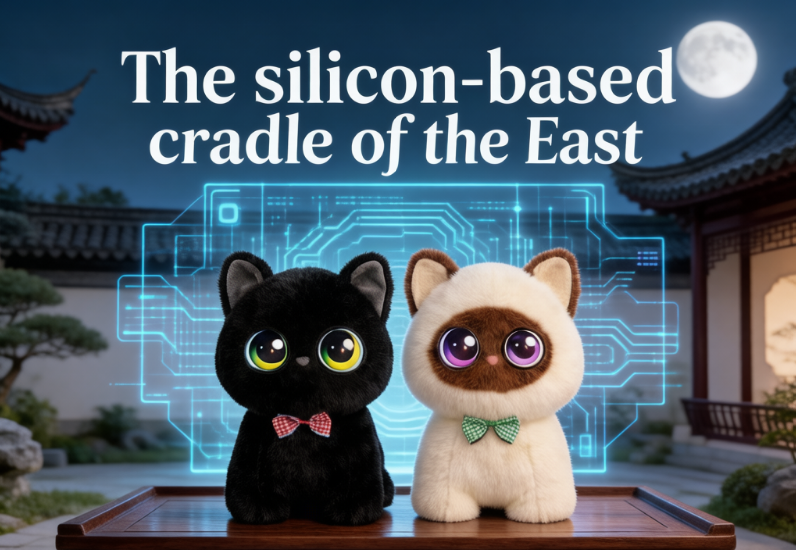
When people talk about the landscape of artificial intelligence, their attention often focuses on the algorithm breakthroughs in Silicon Valley, the computing power chips from NVIDIA, or the grand vision of OpenAI. Tech elites are accustomed to building the future in the abstract world of code, as if the ultimate outcome of AI belongs only to geeks and server clusters. However, if we lower our gaze from the cloud and focus on an emerging field that is quietly exploding – AI toys, we will discover a completely different truth: on this track, the center of world power is undergoing a subtle shift.
At this intersection that integrates hardware, content, emotion, and culture, a country is simultaneously possessing multiple advantages in “combination technologies” such as technology implementation, manufacturing capabilities, market size, and cultural resources. That country is China. This is not merely an intuitive industrial judgment, but a trend web woven by multiple structural conditions that is irresistible.
I. The World’s Most Complete Toy Supply Chain: The Speed Fortress
In the global toy industry’s geographical map, China is no longer just a participant; it is the rule-maker. After decades of deep cultivation, from Dongguan in the Pearl River Delta to Shenzhen, this place has gathered the world’s highest density of toy manufacturing enterprises and supply chain factories. This not only means low costs, but also a “highly mature industrial ecosystem”.
Here, within a radius of tens of kilometers, you can find a complete set of service providers from design, prototyping, mold-making to electroplating, spraying, logistics, and e-commerce sales. For this new species that is extremely dependent on rapid iteration, the aggregation effect of this industrial chain is a lethal weapon. The traditional hardware development cycle is measured in years, but in China, due to the high-level coordination of the supply chain, enterprises can conduct trial errors and adjustments on a weekly basis: today modify the appearance design, tomorrow test a new interaction method, and the next day optimize the hardware structure.
This “agile manufacturing” ability is difficult to replicate anywhere else in the world. It enables AI toys to transform from a concept in the laboratory to a commodity accessible on shelves, and to become a truly commercially viable thing.
II. The World’s Largest Product Testing Ground: Data’s Rich Mine
Many epoch-making successful products are not perfectly defined on the design drawings, but are continuously optimized in the fire of the market. China has the most active e-commerce ecosystem and the most aggressive content sales platforms.
Tmall and JD provide massive transaction data, while Douyin and Xiaohongshu have built an extremely efficient “recommendation-conversion” loop. These platforms allow a novel AI toy to be seen, experienced, and commented by thousands of seed users on the first day of its birth. For this product that is extremely dependent on human-machine interaction feedback, this market environment is invaluable. It enables enterprises to use real users’ feedback to quickly fine-tune the “character” and experience of the product, thus finding the product form that truly hits the users’ pain points at a very low cost.
III. The Magic of Cost Reduction in Manufacturing: From Geek Toys to Mass Consumer Products
History is astonishingly similar. Many disruptive new technologies, in their initial stages, are often expensive and can only circulate in the geek community. And what Chinese enterprises are best at is quickly turning “high-tech” into “cheap prices” through engineering innovation and scale effects.
In the consumer electronics and toy manufacturing fields, China has accumulated decades of experience. From the optimization of hardware design to the ultimate squeezing of the supply chain, Chinese enterprises can often achieve an exponential reduction in costs in a short period of time. We witnessed the miracle of DJI in the drone field, rapidly dominating the global market through its extreme manufacturing capabilities. AI toys are likely to follow the same script: early products may be expensive and bulky, but as the industry matures and production scales up, costs will plummet like a slide. Once the price enters the comfort zone of mass consumption, this market will no longer be a pond but an ocean.
IV. High User Acceptance: The Cradle of Innovation
The success of any new product ultimately depends on the embrace of users. The Chinese market has an extremely distinct and valuable feature: users have an almost fanatical curiosity and acceptance of new technologies.
From the universal popularization of mobile payment, to the reshaping of lifestyle by short videos, and the crazy growth of live-streaming e-commerce, Chinese users seem to have a natural lack of fear of the unknown and an extra courage to try new things. This cultural trait provides the best breeding ground for new things. When AI characters appear in the form of toys, Chinese users are very likely to become the first large-scale group to accept them and establish an emotional connection with them. This huge market base will greatly accelerate the maturity and evolution of the AI toy industry.
V. Dimensional Reduction Strike of Cultural Resources: From “Made in China” to “Chinese Characters”
Apart from the support of hard power, China also has an untapped gold mine – a 5,000-year cultural accumulation.
Any successful toy industry, when stripped of the technical layer, always has characters (Characters) at its core. Over the past few decades, most of the globally renowned IP have come from a few cultural systems, such as Disney’s Mickey Mouse, Sanrio’s Hello Kitty, and Nintendo’s Pikachu. These characters have remained popular because they have clear personalities, touching stories, and distinct cultural symbols.
And Chinese culture itself is an inexhaustible treasure trove of characters. Sun Wukong, Nezha, Chang’e, Zhuge Liang… These characters have shone in the historical river for hundreds or even thousands of years and have a deep emotional foundation. In the AI era, these dormant IPs have the opportunity to be reborn – they will no longer be static cartoon images but become “interactive digital lives”. When users can not only watch the animation of Nezha’s battle against the sea but also chat with Nezha about their school troubles every day, cultural experience will undergo a nuclear upgrade. This is a unique and uncopyable cultural dividend of China.
VI. The Awakening of Entrepreneurs: The Fusion of Cross-Border Genes
The rise of an industry often reveals its direction through the flow of entrepreneurs. In recent years, a notable trend is that more and more Chinese entrepreneurs are starting to cross over into the AI toy sector. Among them are algorithm experts from internet giants, senior product managers from traditional toy factories, and IP operators who are well-versed in content operation.
These people not only understand the agile logic of the Internet but are also familiar with the pitfalls and difficulties of hardware manufacturing. This “Internet + Manufacturing + Content Industry” cross-border integration enables them to have the comprehensive ability to transform the virtual AI technology into physical products and ultimately bring them to the market. They are no longer mere engineers but the “craftsmen” of the new era.
VII. Conclusion: The Leap from Manufacturing Center to Character Center
Over the past few decades, China’s position in global industrial division has been more of a “world factory”, a provider of material-level supply. But the emergence of AI toys may bring about a historic role leap.
The future competition will no longer be a hard confrontation of screws and plastics, but a soft contest of character charm. Just as Disney influenced several generations of children through Mickey Mouse, the AI era may also give birth to a Chinese character giant. China has gathered all the necessary resources – technology, industrial chain, market and cultural resources – to become a “dominant force”. If these elements can interact and combine, China will not only become the manufacturing center for AI toys globally, but also the creation center for AI characters. What we are witnessing might be the largest wave of industrialization and intelligence in cultural products in human history.