


Blog
Still Water Deep: The Flourishing Appearance of the AI Toy Market and the Threshold for Industrialization

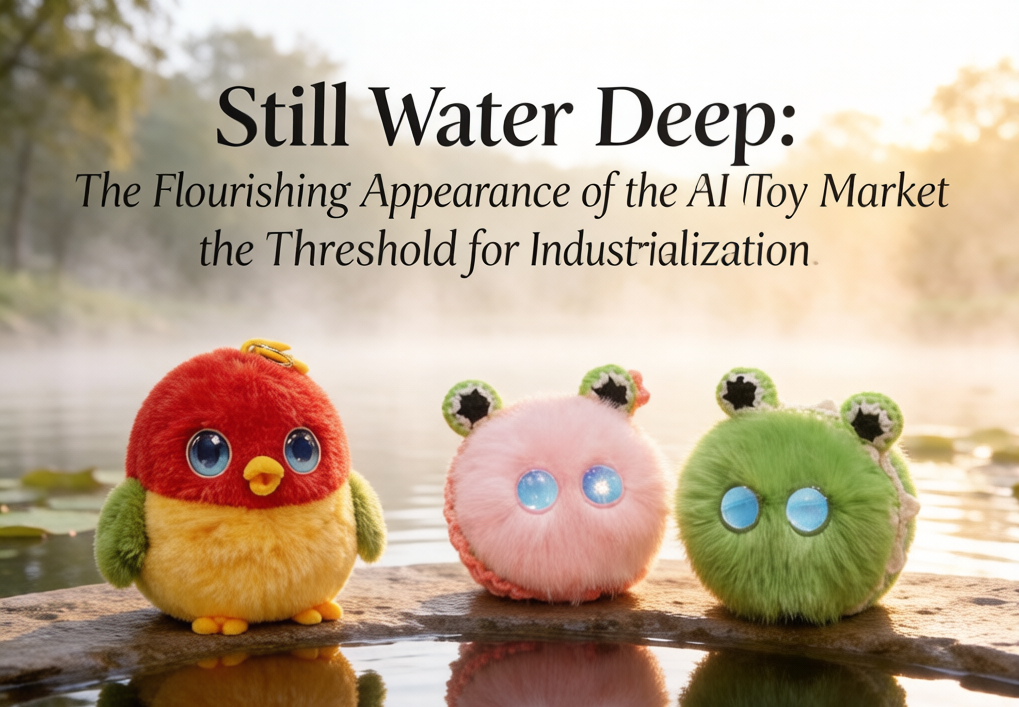
Over the past 24 months, AI toys have undoubtedly been one of the hottest buzzwords in the technology venture capital circle. Under the wave of large model technology, they are regarded as the golden ticket to the C-end market – not only being the best carrier for the application of artificial intelligence in real-life scenarios, but also a perfect example of the combination of “emotional economy” and physical hardware. However, when we remove the spotlight from the media and calmly examine this field, we will find a highly tense sense of disconnection: the concept level is filled with great excitement, but the industrial level is cautious and steady, and the capital level maintains an inexplicable restraint.
As of now, the AI toy sector remains a “three-less” area: there is no national-level hit product that can consistently deliver and penetrate the market segment; there is no verified product model that can be replicated by peers; and there is no self-sustaining business model with a logical loop.
The industry often attributes this delay to the immaturity of technology, but in our view, this actually conceals the essence of the problem. The real hidden threshold of this sector has been underestimated for a long time. It is no longer just the algorithm accuracy in the laboratory, but a comprehensive test involving system engineering, risk control, and industrialization capabilities.
I. Cold-eyed scrutiny from an investment perspective: from “can it be done” to “are you willing to bet”
If you shift the perspective to the investment decision-making meeting room, you will hear a completely different voice. For investors, the main contradiction of AI toys has long been “can it be made”, rather than “are you willing to scale”.
During the Demo stage, almost all AI toys performed flawlessly: they could have conversations with children, sense emotional fluctuations, and even give astonishing philosophical answers. However, once they crossed the threshold of mass production and entered thousands of households, these advantages instantly turned into uncontrollable risk sources. This characteristic of “amazing in the Demo, terrifying in mass production” has placed AI toys in an awkward position of “visible, untouchable, and not willing to heavily invest” in the industrial judgment.
II. Three major industrial-level obstacles to scaling
The obstacles preventing AI toys from entering the mass market are not a single technical bottleneck, but three interlocking industrial-level issues.
1. Stability: From experience flaws to systemic risks
For product managers, occasional irrelevant answers may just be an experience problem; but for investors, this is a fatal systemic risk. The application scenarios of AI toys are extremely special – they often delve into children’s companionship, family interaction, and even private emotional comfort. This means that any inappropriate response, an emotional misguidance, or an inexplicable “crossing the line” behavior could instantly trigger public opinion, trigger regulatory compliance reviews, and even destroy the entire brand.
From this perspective, “not stable” in the industrial logic is equivalent to “not scalable”. No one is willing to build a business empire on an uncertain volcano.
2. The paradox of intelligence: The smarter, the more dangerous
A repeatedly verified industry paradox is that the more intelligent an AI toy is, the lower its commercial certainty becomes. The logic behind this is not complex: the larger the output space of AI, the wider the potential risk coverage; the more complex the context understanding, the higher the probability of misjudgment; and the deeper the intervention in human emotions, the more blurred the responsibility boundary of the product.
For capital seeking certainty, projects that cannot accurately assess risks, cannot be standardized and replicated, and cannot predict long-term reputation are contrary to the core logic of “mass-scale products”. Capital needs is controlled growth, not uncontrolled intelligence.
3. The missing “industrialization thinking”
At present, a large number of AI toy projects still remain in the logic of “technical display” or “geek innovation”, rather than the logic of “industrialized products”. Industrialization means predictable behavior, replicable experience, and manageable risks. But the reality is that many products lack contingency plans for failure: no clear “failure mechanism” (that is, how to gracefully shift the topic when not knowing the answer), no “emotional de-escalation path” (that is, how to return to calm when emotional overload), and no “physical shutdown logic” triggered by boundary violations.
This makes them more like exquisite samples in the laboratory rather than industrial-level commodities that can withstand market challenges.
III. Reassessment of industrial thresholds: From technical capabilities to stability
delivery Standing at the intersection of industry and capital, we can clearly draw a conclusion: The true moat of AI toys is not technical capabilities, but the ability to deliver stability. To achieve this, three factors that have been seriously underestimated must be faced.
1. Boundary Sensitivity: More important than algorithm optimization
A scalable AI toy must establish boundaries like a constitution at the beginning of its design. It must first answer three questions: Who am I? What am I not? What will I never do? The clearer the boundaries, the higher the system’s security and the lower the business risk. From an investment perspective, a product that understands “restraint” is far more worthy of a bet than an all-powerful “monster”.
2. Role Dimension Reduction: Wisdom to Avoid Risks
Stable AI toys are often not the lofty “mentors” or “judges”, but humble “companions”, “feedback providers”, or “sensory providers”. They do not provide value judgments, do not replace parents’ decisions, and only provide stable emotional presence. Such roles are less likely to cross boundaries, less likely to trigger complaints, and are therefore more suitable for entering sensitive family and children’s markets. This is an optimal strategic choice with the best risk-return ratio.
3. Hardware Limitations: The Last Safety Rope
An overlooked judgment is: The essence of AI toys is not “AI + toys”, but “AI limited by toys”. Limited action libraries, fixed display screens, preset sound packages – these seemingly technical compromises are actually the safety ropes of the industry. They converge risks through physical means, fix the user experience, and improve the system’s controllability. This is why pure software virtual companionship products have so far failed to gain industry-level trust – because without physical boundaries for AI, it is uncontrollable.
IV. Conclusion: Slow Down to Go Further
The industry urgently needs to reach a consensus: The key to the scale-up of AI toys is not how high the intelligence limit is, but how stable the experience limit is.
When a product can guarantee that it never oversteps boundaries, loses control, scares, or steals the spotlight at any time, it truly has the ticket to enter the mass market. For this track, we need a judgment closer to the industry reality: AI toys are not unable to go beyond, but must slow down to do it. It is not suitable for harvesting traffic through rapid expansion, nor is it suitable for blindly pursuing the upper limit of intelligence to show off. The most suitable path is: starting from low intelligence, establishing trust through strong boundary design, first running through stable experience, and then discussing the iterative upgrade of capabilities.
In this impatient and eager era, AI toys may be the industry that most needs “dull perception”.