


Blog
Bid farewell to “mobile phone thinking”: As AI hardware evolves from a “convenient tool” to a “preferred role”

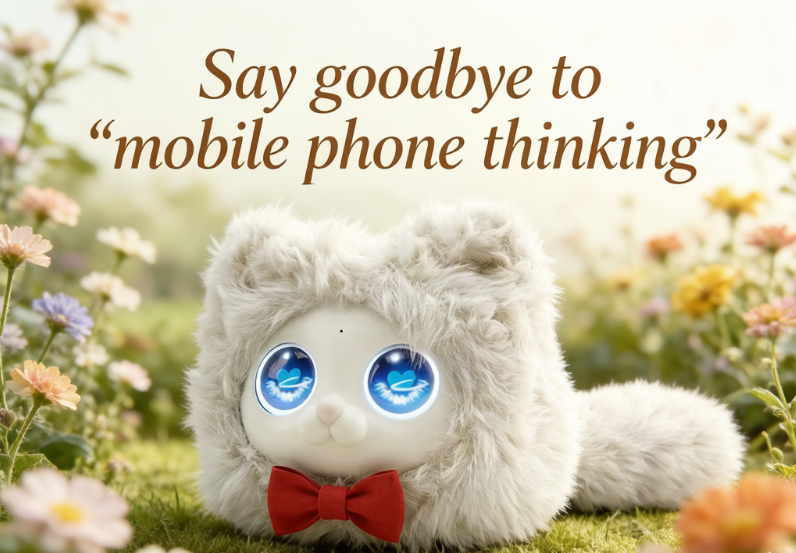
If we still apply the deeply ingrained “mobile phone thinking” from the past two decades to this current wave of AI hardware, especially those various forms of AI companions, AI toys, and emotional hardware, we are very likely to have completely misjudged the direction at the starting line.
In the smartphone era, we established a nearly paranoid rational evaluation system: how much does it score? What are the pixel geometries? What is the refresh rate? Is the price reasonable? What is the efficiency? This logic was once highly effective and it drove the brilliance of the mobile internet, and also deeply ingrained the concept of “instrumental rationality”. However, when we apply this set of standards to today’s AI companion hardware, a strong sense of dislocation arises. A clear market signal is that users no longer simply stay because “it is better”, but because “I like it” instead. This is not a mere emotional marketing slogan, but a deep migration logic that is reshaping the industry chain.
I. The essential leap from “tool upgrade” to “relationship management”
The rise of smartphones was essentially a “tool upgrade”. From feature phones to smart phones, the core narrative was the liberation of performance: faster computing, clearer screens, more functions. The decision-making logic of users was cold and efficient: whoever is better, I will buy it. This was a typical “task-oriented” thinking.
But today’s AI companion hardware is attempting to enter a completely different domain. They often do not directly address a specific pain point, nor promise to improve a specific efficiency. Instead, they often appear in these moments: when you are exhausted from working late into the night, when you are tossing and turning unable to sleep, when you are alone facing an empty room. The common point of these scenarios is that users are not “performing a task”, but “digesting emotions”.
Once entering this dimension, the underlying logic of competition has undergone a qualitative change. Users no longer ask “Can it save me a few minutes?”, but “Who makes me stay longer?” This shift from “efficiency priority” to “emotional priority” means that AI hardware is moving away from pure tool attributes and seeking to establish a “relationship”. This relationship does not focus on the input-output ratio, but on the comfort and sense of security in interaction.
II. The “infrastructureization” of parameter advantages
This is not to say that parameters and technologies are no longer important, but their roles are undergoing a fundamental downgrade. Today, developing an AI hardware, the accuracy of voice recognition, the basic conversation ability of large models, the integration of sensors and chips, have all become highly mature and easily accessible. These capabilities are still important, but they are rapidly becoming “entrance tickets” rather than “decisive moves”.
This is like the smartphone market in the past, when all phones could smoothly access the internet, take high-definition photos, and install a large number of applications, simply comparing “can do something” has no longer been able to impress consumers. What truly sets the gap apart is “how it feels to use it” – the feeling of the fingertips sliding across the screen, the delicacy of the system animations, the overall interaction temperament. For AI companion hardware, the technical foundation is necessary, but what determines whether users stay or leave is the emotional experience built on top of it.
III. The personification of products: from “it” to “he/she”
If you carefully observe users’ language habits, you will find an extremely subtle cognitive change is taking place. When facing traditional electronic products, we naturally use the pronoun “it”. But when describing those successful AI companion devices, users begin to unconsciously switch to “he” or “she”.
This is not a simple issue of language habits, but a profound shift in cognitive paradigms. When an object is called “it”, it undoubtedly is an object, a tool being used. When it becomes “he” or “she”, it enters the realm of “intersubjectivity” and becomes a potential interactive object, a “role” that can establish a relationship. Once this cognitive transformation is completed, the product is no longer just an industrial product on the assembly line, but more like a living entity with warmth and personality. This projection of personality is a crucial step for the emotional stickiness of AI hardware.
IV. Aligning with the Entertainment Industry: The Triumph of Character Appeal
This evolution makes the business model of AI hardware increasingly resemble that of the entertainment industry. The core competitiveness of the entertainment industry has never been “functionality”, but “appeal”. Whether it’s games, films, or IP management, its essence is to create a memorable character and make users willingly stay in the relationship with this character for a long time.
Today’s AI hardware is replicating this path. An AI doll is no longer just a plush toy with chips, but a long-term interactive role carrier. Its value no longer depends on how many transistors are integrated internally, but on whether its “character profile” is rich, whether its personality is likable, and whether it can trigger emotional resonance in users. Future AI hardware companies may need to understand their products like miyageyu understands anime characters; they need to operate their devices like Disney creates IPs.
V. The New Identity of the Product Manager: Relationship Designer
If the above judgment holds true, then the paradigm of product design must also be innovated. In the past, the core work of the product manager was to design functional processes, optimize interaction paths, and improve usage efficiency. They were like architects, meticulously constructing a series of fully functional “buildings”.
But in the field of AI companion hardware, the product manager needs to transform into a “relationship designer”. They no longer need to think about where the buttons are the most convenient, but rather: How will this role respond when the user is in a low mood? How strong should its presence in daily life be? How will its relationship with the user deepen over time or remain unchanged? This is more like writing the biography of a character and giving this character a logic of “existence” in the real world. This design no longer pursues logical rigor, but seeks emotional coherence and authenticity.
VI. Release as “Launch”: The Birth of a Character
This transformation of thinking will also completely change the form of product release. Traditional hardware launches are often filled with the stacking of parameters and comparisons of benchmark scores. But the future release of AI hardware may be more like a film promotion or the launch of a game character.
At the launch, the presenter may not introduce the configuration in detail, but instead passionately explain: “Who is this character?” “How will it accompany you?” “How will its relationship with you evolve over time?” 。 What the user purchases is no longer merely a cold hardware, but a commitment – “I am willing to entrust a part of my life to this existence”. This purchasing behavior is essentially an investment in a potential relationship, rather than a transaction for a tool.
VII. Reconfiguration of the Business Model: From Transaction to Companion
When the product evolves into a relationship, the business model will inevitably be reshaped. The traditional hardware sales is a one-time transaction: buy once, use for a period of time, and then end. However, under the “relationship logic”, the hardware is more like an “entry point” to a certain lifestyle.
The subsequent business model will be closer to games (continuous content updates), membership systems (value-added services), and IP operations (related derivatives). The continuous deepening of the relationship will bring about continuous service consumption. Users no longer pay for the hardware itself, but for the time spent with this “character” and the emotional value brought by this relationship. This is a profound transformation from “ownership” to “use rights” and “experience rights”.
VIII. Advantage Migration: Who Will Dominate the Next Decade?
Following this logic, the industry’s advantage pattern will also undergo significant migration. Being good at hardware integration and supply chain management remains an important underlying capability, but these companies may gradually retreat to the background and become standard “capability providers”.
What truly determines differentiation and high premium is those companies that are better at understanding human nature, perceiving emotions, and designing relationships. This explains why more and more content companies, game companies, and even psychological counseling institutions are entering the AI hardware sector – they are not engaging in cross-industry experimentation, but rather entering with the inherent gene of “relationship design”. The future competition will be the victory of “emotional quotient” over “intelligence quotient”, and the complementation of “empathy” over “computing power”.
IX. Conclusion: The “Being” That Is Liked
Summarizing all these changes into one sentence, it is: AI hardware is evolving from “a tool to be used” to “an existence that is liked”. Once the product needs to be “liked”, its competitors are no longer limited to similar hardware, but all things that can occupy users’ time and emotions – including games, films and television, social media, and even real-world friendships.
When the value of a device no longer depends on how long you have used it, but on whether you will recall it at a vulnerable or lonely moment, the game rules of this industry have completely changed. At that moment, it no longer looks like a phone, but more like a character, a companion, quietly entering your life and staying for a long time. This might be the ultimate romance of AI hardware and its most solid commercial barrier.