


Blog
The Brain Inside the Shell: When AI Toys Become the “Hosts” of Heterogeneous Thinking

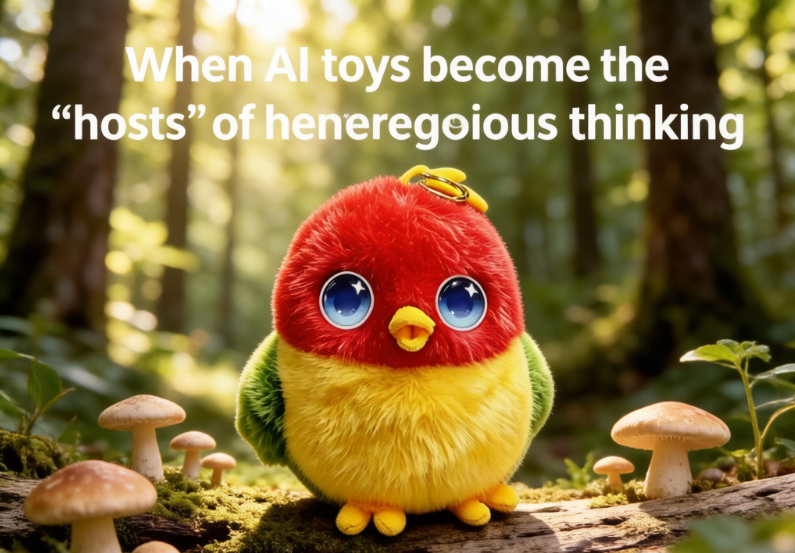
Recently, I spent a lot of time immersed in the ocean of AI toys. At first, I thought I was merely observing the iteration of a new category, but the longer I looked, the stronger the sense of incongruity became. These products, although collectively called “AI toys”, although all have a plush or silicone casing, their “souls” are completely different and even mutually exclusive.
You will find that some products are created by the cleaning robot team, with an engineering rigor at their core; some come from the AI conversation product manager, full of interaction logic imprints; some are more like physical extensions of social products, attempting to replicate the connections on the internet in the physical world; and even some are clearly showing an aloof air of an art installation, not caring about whether they are “useful”, only caring about whether they “exist”. They look like toys, but their behavior style is completely unlike that. I originally thought this was just a conventional cross-border mix of “AI + toys”, but after delving deep into the core, I discovered that this is not a simple patchwork, but a silent “species invasion”.
I. The Masked Shell: The Abused Definition of “Toys”
If viewed solely from the physical form, these products seem to share the same set of DNA: they are all plush or small hardware devices, all possess certain interactive capabilities, and all attempt to create a faint sense of “liveliness”. However, once you shift your gaze from “what it is” to “how it is used”, a huge gap emerges.
Some products are essentially a ready-to-use conversation window. You activate it not for petting, but for inputting instructions or sharing your thoughts. Its feedback logic is similar to that of ChatGPT, just with an extra layer of fur. Some products are a mobile social signal. Its significance does not lie in the internal interaction within the family, but in the gazes, inquiries, and recognition it can trigger when you take it out of the house. It is your personality’s badge. Some products are more like a stubborn space placeholder. It does not require frequent interaction, or even doesn’t need to be powered on. It simply needs to stay quietly on a bookshelf or bedside, using its existence itself to declare a commitment to companionship.
These differences are far from minor functional adjustments; they define completely different human-object relationships. They are not selling the same thing, but rather promoting four completely different lifestyles.
II. The Trace of Ancestry: Unveiling the Identity of the Invaders
To understand this disconnection, we cannot merely look at the products themselves; we must examine the “mother bodies” that created them – the past and present of those founding teams. An extremely notable feature is that none of the creators of this wave of AI toys were “natively born” from the traditional toy industry.
They are a group of cross-border immigrants. Those from robotics and hardware companies are accustomed to communicating with the world through sensors and actuators, and their instinct is to make machines “work”. Those from AI product and large model teams believe in algorithms and data, and their instinct is to make machines “think” and “generate”. Those from consumer electronics or social products are proficient in traffic distribution and user stickiness, and their instinct is to make machines “connect”. And those from interaction design or art backgrounds pursue experience and concepts, and their instinct is to make machines “express” and “reflect”.
None of them intended to make “better toys”; they were merely seeking a suitable “shell” to load their already familiar product logic. Toys, unfortunately or fortunately, became the chosen container.
III. The Rewrite of the Container: Toys as “Hosts”
Thus, we witnessed a peculiar “shell listing”. The ancient container of toys is being forcibly rewritten by logic from different dimensions.
The AI toys made by engineers, when stripped of the fur, are an extension of a hardware system. Its core indicators are stability, battery life, and response speed, like a precise instrument.
The toys made by AI teams, when the core is removed, are the physicalization of a conversation product. Its value lies in the parameters of the large model, the context length, and the illusion control, like a software.
The toys made by consumer electronics or social product teams, through the surface, are a new entry point for a usage scenario. Their success depends on daily active users, retention, and conversion rates, like an internet application.
And the toys made by design or art teams are more like an experimental device for relationships. Its significance is not in solving problems, but in posing questions, such as “What is companionship?”, like an exhibit in an art gallery.
Here, toys have completely become a physical carrier, a “shell”. The logic that truly drives it is those completely heterogeneous logics transplanted from robotics, the internet, social networks, and the art field.
IV. Non-Design Evolution: Natural Occurring Variation
The most interesting aspect is that all of this did not arise from some grand top-down design. No one sat in an office and said, “We need to restructure the toy industry.” But when people from different backgrounds, with their own preconceived notions and successful experiences, converged onto the same physical platform, variation naturally occurred.
Just like the current AI toy ecosystem: there is no unified command, no standard paradigm, yet it is increasingly unlike any toy from our childhood memories. It is difficult to evaluate it simply by saying “Is it fun?” A product that originated from a vacuum cleaner robot, for instance, is absurd to call it “fun”; a product from an art installation background is also absurd to demand it to be “long-lasting and enjoyable”.
The alternative evaluation system is: What role does it play in your life? Do you think of it when you are alone, or wear it when you are socializing? Do you charge it regularly, or leave it in the corner to accumulate dust? These questions point to its position in the user’s life structure, rather than its entertainment attributes.
V. The qualitative change of relationships: From “objects” to “existence”
If we extend the timeline, the changes brought about by this invasion become even clearer. The past toys, no matter how expensive, were essentially “purchased objects”. Their life cycle was linear: bought -> played for a while -> forgotten in the storage room. The transaction was completed, and the relationship basically ended.
Now this wave of AI toys is evolving into a “continuous relationship”. They are not bought once and then abandoned, but continuously “entering”. They appear in your morning, evening, and night; they record your emotions, respond to your calls, and even shape your habits. This difference does not lie in the number of functions, but whether it has embedded itself into your daily relationship structure. It is no longer an “object”, but a “node”.
VI. Division and Convergence: The Dialectic of Industry Evolution
When these heterogeneous logics are forced to squeeze into the same narrow shell, industry division is inevitable. We see some people moving towards deep companionship, some towards social media, some towards pure existence, and some towards emotional consumption. On the surface, it is the products that are differentiating; in essence, different industries’ “understanding methods” are simultaneously engaged in a melee on the battlefield of AI toys.
However, beneath the surface of division, a deeper convergence is quietly taking place. Although the paths are different, these products will eventually face similar ultimate questions: How to keep users using it continuously? How to establish a stable and bounded relationship that neither crosses boundaries nor becomes indifferent? How to transition from the initial “novelty” to a long-term “dependence”?
These questions are not exclusive to the toy industry; they are universal challenges that all “user-oriented products” must face. This means that the toy industry is transforming from an independent, material and craftsmanship-centered manufacturing industry into a “relationship industry” that can be uniformly explained by the logic of the Internet, psychology, and sociology.
VII. Conclusion: The Ultimate Examination Hall of the Relationship between Humans and Technology
Following this trend, a more grand change is emerging: In the future, what determines the form of AI toys will no longer be those experts who understand injection molds or IP operations, but those thinkers who better understand the “correct relationship between humans and technology”.
Because the core contradiction of AI toys is no longer “Is it fun?”, but “How to coexist?” How can it be used by us without enslaving us? How can it be remembered by us without being forgotten? How can it exist long-term without becoming a burden? These products are actually all the possible scenarios that humans practice coexisting with silicon-based intelligence at the micro level. They are micro social experiments, testing technological ethics, emotional boundaries, and existential meaning.
When toys are no longer toys, they become a mirror for us to examine ourselves. What is reflected in the mirror is not only the future of technology, but also the abyss and brilliance of human nature.