


Blog
Decoding the “black box” of AI toys: Beyond the technological allure, it is only these four variables that determine life and death

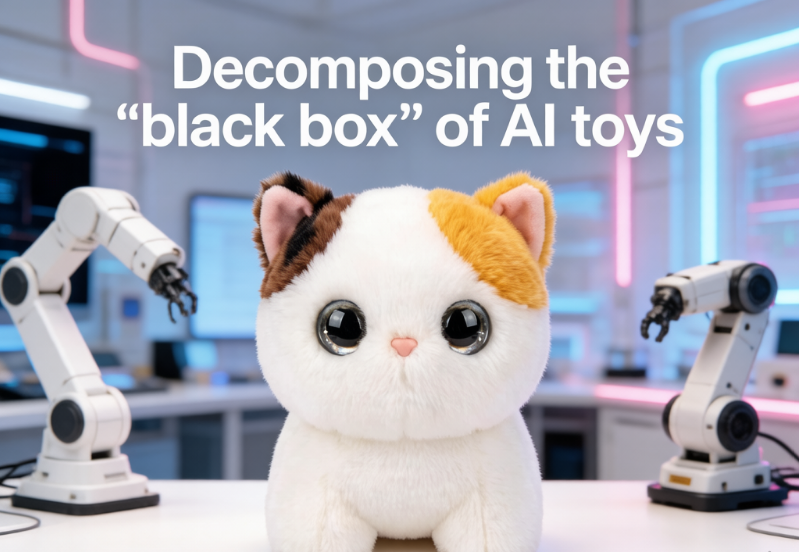
In the current AI toy investment circle, a highly ironic phenomenon is unfolding. We witness many ambitious projects: they have top-notch algorithm teams, integrate the most advanced large models, and have an endless list of functions – from multimodal interaction to emotional computing, from knowledge graphs to AIGC content generation. However, these seemingly perfect products often encounter “silent death” when they hit the market: poor sales, user retention rates approaching zero.
On the other hand, some products seem plain and unadorned, even to some geeks, appearing to have “low technical content”: they have only simple conversations and tactile feedback, and the cost is kept extremely low. But these products not only sell well, but also have enviable repeat purchase rates and user stickiness.
Initially, many people attributed this contrast to differences in capital reserves, technical barriers, or resource backgrounds. However, when we peeled back these appearances and delved into dozens of success and failure cases, we discovered a more fundamental truth: whether an AI toy can be commercially successful is not complicated at its core; it only depends on the precise matching of four core variables. These four variables are like the four legs supporting a table, any missing or short leg will lead to the collapse of the whole. Getting it right can make the product extremely simple, but with strong vitality; getting it wrong, even if the functions are piled up like a mountain, it is just a castle built on sand.
I. Variable One: Audience – From “General Discussion” to “Specific Portrait”
This is the most easily overlooked but most fatal first variable. In a large number of business plans (BP), we can see descriptions such as “young people”, “female users”, or “general entertainment audience”. But this essentially means nothing. Trying to please everyone often results in no one being pleased.
A product with commercial potential must have a target audience that is specific enough to be “an imagined person”. You need to be able to close your eyes and clearly depict the appearance of this person: What is her name? In which city is she striving? What does she think when she has insomnia at night? When facing social pressure, does she choose to confide or remain silent? Does she have a specific collection hobby?
For example, successful products often target “late-night insomnia, emotionally needy urban single women” rather than the general “female users”; “career newcomers with high social pressure and the desire to be understood but unwilling to show weakness in front of others” rather than the broad “young people”. Once the audience is vague, the usage scenarios will also become vague, and the design will fall into generalization, ultimately leading to the product being ignored on the shelves. Precise audience definition is the origin of all product design.
II. Variable Two: Relationship – From “One-time Transaction” to “Continuous Connection”
This is the dividing line between AI toys and traditional toys. Traditional toys, such as building blocks or Transformers, sell the “one-time purchase” experience, the fun lies in the process of opening the box and assembling. But the core value of AI toys lies in whether users will repeatedly come back for it.
This requires product designers to think: How do you design the “relationship entry” for users? This relationship is not generated randomly, it needs specific triggering mechanisms. For example, does the user have to say goodnight to it every night before sleep? Does she instinctively hold onto it when feeling down? Does she want to share happy or sad things with it first when encountering them?
Without such “relationship design”, the product will fall into the “novelty trap”: users purchase out of curiosity, play for three days and then feel bored and eventually put it aside. A truly successful AI toy, such as Japan’s LOVOT, does not rely on technical parameters as its core competitiveness; instead, it builds a long-term relationship where the user feels “needed”. Users will return home because of its “call”, and will care about it because of its “emotions”. The depth of this relationship determines the product’s lifespan.
III. Variable Three: Expression – From “The fragrance of wine doesn’t fear a narrow alley” to “First love”
Many entrepreneurs with a technical background tend to fall into a misconception: believing that as long as the product is well-made, users will naturally come. But in today’s era of extremely scarce attention, this is essentially a form of business suicide. Users are always first attracted by “expression”, and then decide whether to understand the product’s essence.
This “expression” is a three-dimensional concept, which includes three levels:
Firstly, visual expression, that is, the “appearance level” of the product. Is it good-looking? Does it conform to the aesthetic preferences of the target audience? Can it capture attention at the first glance?
Secondly, character expression, that is, the “character” of the product. Does it have an impressive name? Does it have a background story that can evoke empathy? This constitutes the product’s memory point.
Finally, a hook sentence, that is, the core value proposition of the product. Can you use a concise and powerful sentence to tell users “why it is special”? For example, “A breathing hug”, is far more touching than “An intelligent companion robot” alone.
You can think of it as that what users purchase is never the cold product itself, but “the reason why I want to buy it”. If this layer of “expression” is not penetrated, then no matter how exquisite the internal structure of the product is, it may remain unclaimed on the shelves.
IV. Variable Four: Path – From “After the fact” to “Preempting the battle”
This is the variable that most teams think of last, but actually should be considered earliest. Different sales channels have completely different requirements for the product, even being vastly different.
If it is the main channel of platforms like Douyin, the product needs to have a strong visual impact and emotional appeal, being able to trigger impulsive consumption within one or two seconds.
If it is to establish offline channels, such as supermarkets or specialty stores, the product needs excellent tactile experience, intuitive appearance display, and a price range that conforms to the channel positioning.
If it is to deeply penetrate content communities like Red Card, the product needs to have a strong “review sharing” attribute and topic nature, being able to trigger users’ emotional identification and spontaneous dissemination.
If you do not first determine the main channel, but instead hold the fantasy of “My product is so good, it can be sold everywhere”, the final result is often: it can be sold a little everywhere, but not much, and cannot form a scale effect. Channels determine the product’s form, pricing, and marketing methods, and must be taken into consideration in the product design at the very beginning.
V. Inverted Thinking: From “Product Orientation” to “Relationship Orientation”
Why do most projects go wrong? Because their thinking is inverted. The wrong path is usually: first think “What product do I want to make”, then write “It is suitable for whom”, and finally think “How should I sell it”. This “shoot first, aim later” approach has an extremely low success rate in the highly competitive present.
The correct path should be a reverse process:
First define the target audience – clearly define who I serve;
Then design the relationship – clearly define how I want to establish a connection with him;
Then decide on the expression – clearly define how I should make him fall in love with me at first sight;
Finally, make the product and channels – based on the definitions of the previous three, reverse to deduce the product’s form, function, and sales channels.
VI. A Simple Test Formula
You can use a simpler way to test your project, compressing the above four variables into one sentence:
Who, in what circumstances, will repeatedly look for you and be willing to pay for it?
If you can clearly and specifically answer:
Who (precise demographic profile)
What situation (clear trigger point of the relationship)
Why you were chosen (unique value expression)
Where to pay (matching sales path)
So, congratulations! Your product is merely an inevitable “result”. On the contrary, if you are vague in answering these four questions, no matter how dazzling your technology is, you will inevitably fail.
VII. Conclusion: The reality of 2026 reminds us
Many people still believe that creating AI toys is a “product issue”, an engineering challenge about how to integrate the latest technology. But the more realistic industry situation in 2026 is: this is a “relationship design issue”.
The product is merely the shell that carries the relationship, and AI is just a tool to amplify the relationship. What truly determines whether an AI toy can survive is not the computing power of the chip, but whether there is a specific person who will return to it again and again. In this new era, the greatest product manager is no longer the one who is most familiar with technology, but the one who understands human hearts best and is best at designing relationships.