


Blog
From “Audio Illusions” to “Touchable Life”: When AI Toys Can Simulate Heartbeats, Who Cares How Smart They Are?

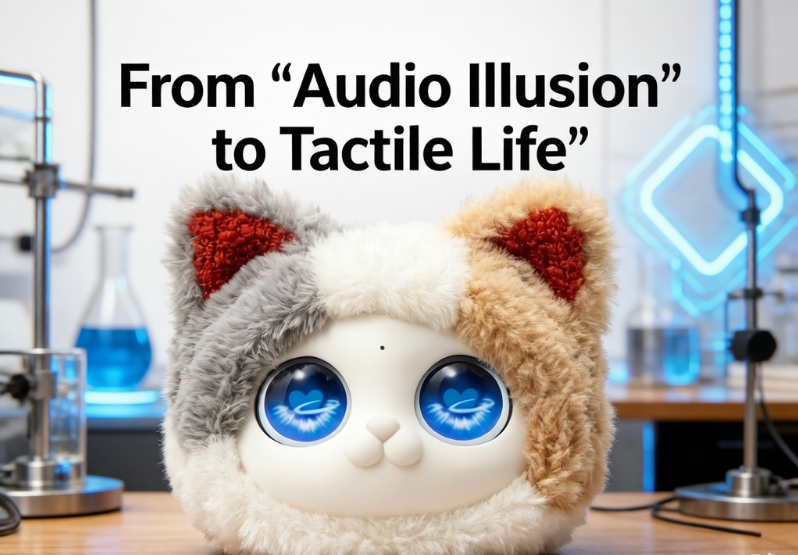
During that period, I fell into a kind of professional burnout. The desk was piled high with various AI toy samples. I was like a strict examiner, conversing with them day after day. They did become increasingly intelligent, able to quote from classics, to speak eloquently, and even to defuse logical traps I deliberately set. However, at the moment the screen went dark or the voice stopped, a huge sense of emptiness overwhelmed me. They seemed to “disappear” like ghosts, without temperature, weight, or any evidence of existence in the three-dimensional world, and without any reason for me to feel the slightest “need for it to stay”.
This experience suddenly woke me up to a blind spot that the entire industry had overlooked: If an AI only “exists” when you actively initiate a conversation and then vanishes when there is silence, it is essentially just a tool wrapped in the guise of a toy – a voice assistant running on a silicon-based chip. In human history, all the truly relied-upon existences were not those “things that answer questions”, but those that could be truly felt. Thus, a profound dividing line emerged in the field of AI toys: One type of product is still desperately competing to be “more intelligent in conversation”, attempting to go further on the Turing test path; while the pioneers of the other type began to attempt to answer a more difficult and more fundamental question – how to make AI be touched and respond to this touch like life itself.
I. From “Answering Machine” to “An Existence Needed”
Looking back over the past two years, the AI toy industry almost fell into a collective hysteria: Everyone was striving to make toys “smarter”. More natural pauses, more human-like tones, more extensive knowledge bases… These technical indicators became the sole criterion for measuring products. However, a core commercial paradox remained unresolved: Why should users keep a long-term attachment to an AI toy?
If its core value is merely “being able to speak”, then its competitors are simply too powerful. The voice assistants in mobile phones are always on standby, the large models in the cloud know everything, and even the future lightweight AI glasses can provide round-the-clock information services. These substitutes are stronger, more convenient, and more all-round. But we have never seen anyone fall asleep with a mobile phone, and very few people bury their faces in a cold chat window when they are emotionally broken. This is the crucial dividing line: The true competitiveness of AI toys is not the “dialogue ability” of a single dimension, but a systematic engineering to build “the ability to be relied upon”. In all sensory channels, touch is the only one that can establish this deep physiological dependence.
II. Touch: The Original Emotional Interface That Rides Beyond Reason
Among all the senses, touch is the earliest developed, most primitive, and most direct emotional interface for humans. Developmental psychology tells us that a baby, before understanding any language or seeing clear outlines, can already obtain the most basic sense of security through the mother’s embrace and skin contact. For adults, when the flood of emotional waves hits, our first reaction is not to talk, but to hold onto something, grasp something, and lean on something. This is an instinctual survival instinct ingrained in our genes.
The greatness of touch lies in that it bypasses the cerebral cortex responsible for logic and reason, directly acting on the limbic system – our emotional center. This means that touch is a much deeper form of interaction than language. When an AI toy is endowed with touch, it completely breaks away from the single identity of “information provider”, evolving into an emotional receiver, a body companion, and a stress reliever. This is a completely different product logic: From “I transmit information to you” to “I share existence with you”.
III. Granting AI “Physicality”: A Weapon Against Emptiness
The greatest inherent defect of AI technology lies in its “fictitiousness”. It is merely a string of code and a probabilistic prediction. You know it is running in some corner of the server, but you can never “feel” it in the physical world. And touch sensation is precisely the key to filling this existential gap.
When a toy is designed to have real weight, a constant body temperature, a rhythm of simulated breathing, and immediate feedback when touched, a miracle occurs. It is no longer a static object, but an “existential entity” with a physical presence. This sense of physical existence triggers an ancient mechanism deep in human psychology: we unconsciously regard it as an “object” rather than a “thing”. This explains why humans can develop a deep attachment to non-intelligent plush toys – even if they do nothing, simply because “it feels comfortable to hold”. When an AI with learning and memory capabilities combines with this touch sensation, this attachment will be magnified several times, evolving into an unbreakable emotional bond.
IV. Tactile Language: The “Second Expression System” of AI
Most practitioners have a cognitive misconception that AI’s expression can only be through “language”. But truly advanced life interactions are often silent. Recall the intimate relationships between people: a long embrace is often more effective than a hundred bland comfort words; a pat on the back is more powerful than any logical explanation; and sitting side by side in silence often has more healing power than endless advice.
Tactile sensation is essentially a sophisticated “non-verbal expression system”. If we systematically integrate this into AI toys, they will have an entire “tactile language”. Slight continuous vibrations can express happiness and excitement; the slow and regular rise and fall of the chest cavity can convey comfort and companionship; the acceleration of simulated heartbeat can represent empathy and tension; and the subtle rise in body temperature can symbolize closeness and dependence. This means that AI is no longer merely responding passively to you, but actively “feeling you and responding to you”. When users start to understand an AI through “feeling” rather than “hearing”, this product has crossed a qualitative threshold – it transforms from a cold tool into a living relationship.
V. Building an “Integrated Soft and Hard” Experience Fortress
At the technical level, AI-based voice technology is experiencing brutal homogenization competition. Model capabilities will converge, conversation experiences will level out, and even unique personality settings can be easily replicated through Prompt engineering. But touch sensation is different; it involves an extremely complex system engineering with extremely high barriers.
This not only concerns the selection of materials – how to find a fabric that is soft, has elasticity, and is safe to touch; it also concerns the internal structural design – how to simulate the texture of a living being through supporting components, wrapping layers, and deformation structures; it also involves the training of dynamic feedback – the selection of vibration motors, the layout of pneumatic structures; and the safety and accuracy of the temperature control system. Most importantly, the quality of touch sensation is difficult to measure through parameters; it depends on the meticulous polishing of numerous small details, such as whether the vibration frequency is natural, whether the breathing amplitude is reassuring. These subtle differences in experience cannot be replicated through code, but can only be optimized through long physical iterations. Therefore, touch sensation has become the few abilities that can enable AI toys to form an “experience monopoly”, and is the most solid wall against plagiarism.
VI. The Golden Race for Tactile Implementation
Of course, not all AI toys need to introduce a complex touch sensation system. The value of touch sensation is proportional to “emotional intensity” and “frequency of physical contact”. The following several types of races are the best test fields for introducing touch sensation. First, there are emotional companionship products, which represent the core scenario with the greatest tactile value. To address the needs of loneliness, anxiety, and stress relief, plush AI toys, pillow-type AI devices, or sleep companionship robots can provide the most direct psychological comfort through touch. Secondly, there are healing and therapeutic products, which represent a high-margin market segment. For psychological restoration and emotional regulation, such as emotional soothing toys and meditation-assisting devices, touch is the core medium for their therapeutic effect, with a high potential for average transaction value. Furthermore, there are children’s growth companionship products. For children, touch is the key to establishing a sense of security and attachment. Children’s AI companions or bedtime story toys, through touch, assume the role of “substitute companionship”, and can build user stickiness for several years. Finally, there are IP character-type toys. For products with a strong IP background, touch should not merely be a function but should become “part of the character”, allowing fans not only to love the story of the character but also to love the “real” touch of the character.
VII. Conclusion: Emotional Interactive Lifeform
When touch, AI, and IP are deeply integrated, the essence of toys will undergo a fundamental transformation. It will no longer be a “thing used”, but a “being relationalized”. It will have its own biological clock and state, its own breathing rhythm; it will respond to your touch and also influence your emotions. You will no longer merely “use it”, but hold it, rely on it, and get used to its presence by your side.
On that day, it will no longer be the “toy” in our traditional understanding. It is an “emotional interactive lifeform”. It does not have a carbon-based body, but possesses a silicon-based intelligent soul and a touchable body. It may not be able to run in the complex physical world, but it can firmly occupy the softest corner of our hearts. This might be the ultimate romance of AI hardware – not to make humans work more efficiently, but to allow us to have a warm presence that can be embraced in this sometimes cold world.