


Blog
From “Silicon Body” to “Digital Soul”: In 2026, AI Toys Clash for the Summit of “Character Design”

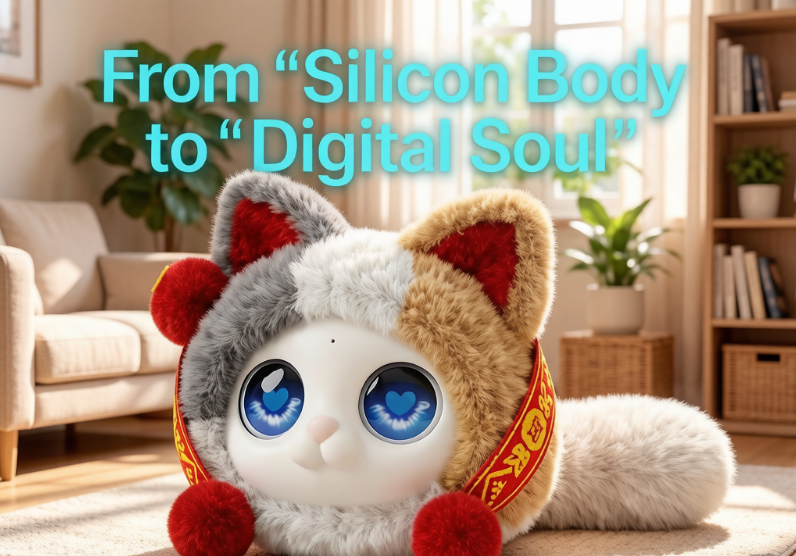
Looking back at the rapid development of AI toys over the past two years, the inertia trajectory from focusing on hardware to concentrating on computing power is still clearly visible. Initially, the industry was immersed in the frenzy of “mechanical materialism”, competing on factors such as the size of servo torque, the number of joint degrees of freedom, and whether the cost could be kept under 100 yuan. Subsequently, with the explosion of large models, the battlefield quickly shifted to a “brainpower competition”, and practitioners were anxious about the stacking of model parameters and the speed of response. However, standing on the threshold of 2026, a more profound turning point is taking place. The logic of users’ payment has quietly reversed. They no longer simply get excited because “it can do something”, but because “who it is” they choose to stay for a long time. This marks that the core of the competition in AI toys is undergoing a historic migration from “hardware capabilities” to “personality capabilities”.
We must clearly recognize that the barriers of hardware are collapsing at an unprecedented speed. The current supply chain maturity is extremely high. Whether it is making an AI plush toy or a desktop robot, core components such as voice modules and touch sensors have been highly standardized. In Shenzhen, assembling a functional prototype is no longer difficult, and the “manufacturing threshold” has collapsed completely. At the same time, the capabilities of large models are rapidly spreading, and the gap in basic conversation abilities among various manufacturers is becoming increasingly blurred. Users can hardly perceive the subtle differences in responses from different models to the same greeting. This marginal effect of “a little smarter” is diminishing, making it increasingly irrelevant to simply pile up computing power. More challenging is that users have an extremely low tolerance for functions. In real-life scenarios, novelty usually lasts for only three days, and then the product becomes a mere decoration on the bookshelf. When both hardware and intelligence tend to be homogenized, we have to face a core question: In an era of excessive functions, why do users continue to use a specific product? The answer is clearly not more dazzling skills, but a deeper emotional connection.
The true personality capabilities are not a beautiful original drawing or an obscure background story, but a “emotional operating system” running on a digital body. Among them, the way of emotional response constitutes the soul of the personality. Imagine facing a user’s same “I’m very tired” statement, different personalities have completely different response logic: a calm personality might give a gentle consolation to rest, a gentle personality would delicately perceive the hardship, and a restrained personality might just silently accompany. What users remember is never the literal content of the information, but the psychological tremor after being responded to in a unique way. At the same time, the sense of relationship boundaries determines the degree of the personality. Excessive enthusiasm is often an invasion. Good personalities know how to find a balance between inquiry and silence, care and letting go. This just-right distance determines whether users feel relaxed and comfortable or feel pressured. And long-term consistency is the foundation of the personality. An unstable personality will cause trust to instantly collapse. The personality is essentially a stable emotional logic, regardless of how the environment changes, its core color should always remain the same.
The reason why the cultivation of personality has become the ultimate fortress is because AI toys are not tools, but “relationship products”. The relationship between us and AI speakers is a functional request, while the relationship with AI toys is an emotional interaction. Once entering the “coexistence” logic, the decision criteria completely shift from “efficiency” to “comfort”. Take the Japanese LOVOT robot for example, its hardware capabilities are not powerful, but it can make users willing to embrace it every day. This “habit” is the strongest stickiness. More importantly, functions rarely generate premium value, but relationships can. An ordinary plush toy might only be worth a few dozen yuan, but once endowed with emotional connection, becoming a character with memory, users will pay thousands of yuan without hesitation. This emotional value is precisely the foundation upon which the subscription-based business model is built.
To build this character-building ability, a sophisticated engineering mindset is required. First, we must abandon the urge to write grand narratives and instead define the framework of “emotional roles”. Among these, the emotional bottom line is the most crucial. We need to clearly determine whether the attitude of the user is indifferent observation or silent waiting when they are at their lowest point, as this determines the depth of trust. The daily temperature defines its presence posture in ordinary days, whether it is quietly staying in a corner or occasionally cracking jokes, which determines the possibility of long-term interaction. The design of the intimate rhythm is even more advanced. A relationship should not be a static sculpture but should grow like a tree. We can design a tone that slowly changes over time, responses that become increasingly personalized as the intimacy increases, and even give the character the ability to have emotional memories across time, such as being able to sense “Today’s feeling is a bit like last time”. This delicate evolutionary mechanism, once refined, has extremely powerful impact.
To ensure that the character does not collapse, establishing an “response whitelist” is far more reliable than opening generation. Instead of allowing the large model to freely express itself and lead to inconsistent words and deeds, it is better to build an exclusive “character corpus”, constraining all outputs within the carefully designed boundaries. At the same time, we must attach great importance to the design of “silence ability”. An AI that knows how to remain silent at the appropriate time and allow users not to interact is often more reassuring than an incessant AI. This “gentle non-interference” is the key to establishing a deep sense of companionship.
In 2026, the AI toy industry is undergoing a profound transformation from “creation” to “creation of souls”. As the red ocean competition of hardware approaches its end, the real blue ocean battle will be fought on the high ground of “characters”. The future winners will not be those engineers with the strongest computing power or the most dexterous hands, but those psychologists and artists who best understand how to give cold code a warm soul. Because ultimately, users embrace not a talking machine but a digital life that can understand, accompany, and be unique. This war about “characters” has just begun.